This Wasn't in the Brochure
A field guide for co-parenting neurodivergent children — written from inside the storm, not the clinical sidelines.
Listen while you read
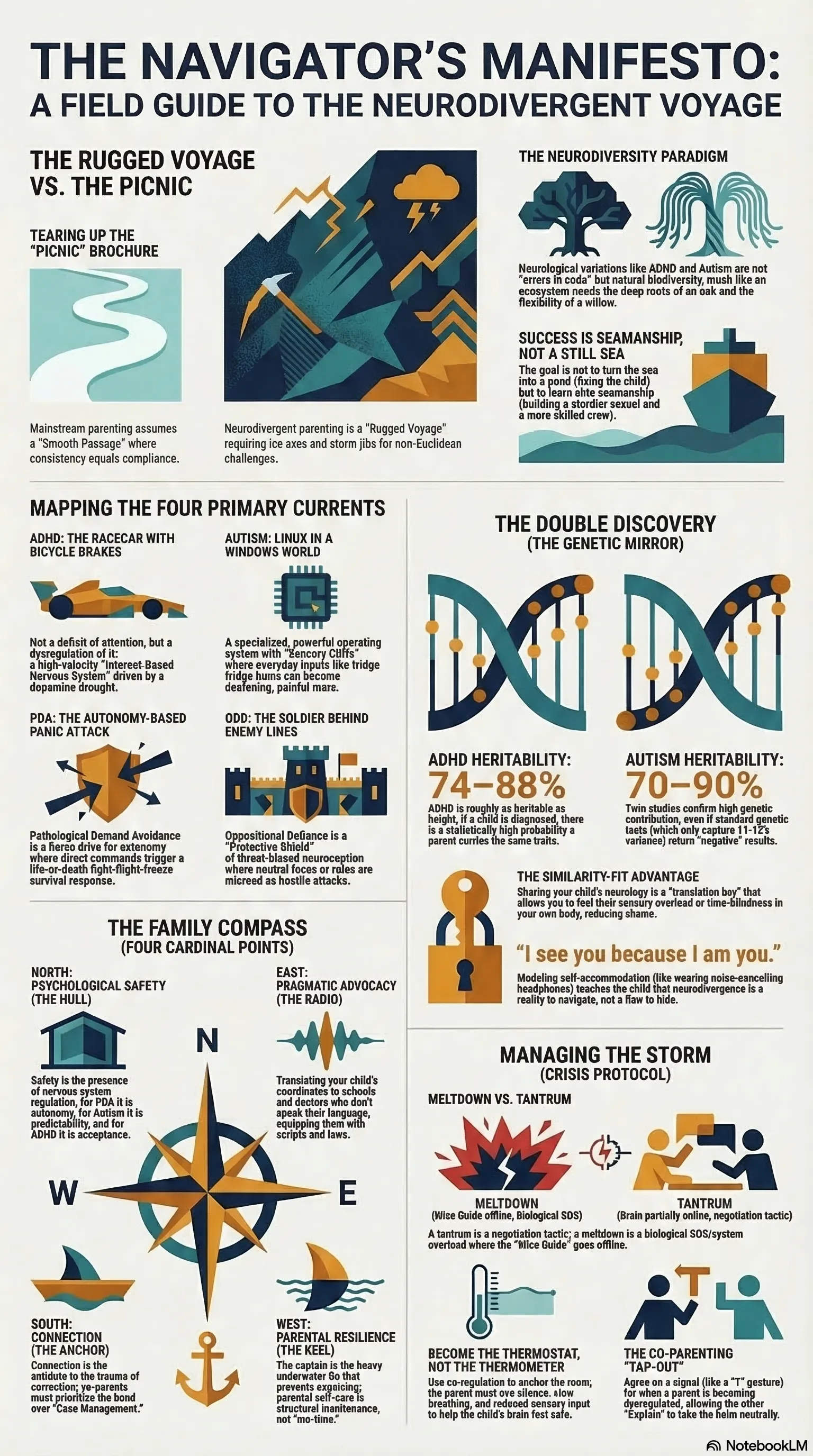
You packed for a picnic. You ended up in the Drake Passage.
This Wasn’t in the Brochure is for the parent standing in the kitchen at 7:43 a.m., muscles trembling after holding a child through a meltdown, thinking: Nobody told me it would be like this. It is for the co-parent sitting in the car after the school meeting, too exhausted to speak. It is for the mother who read the ADHD checklist for her daughter and thought, Wait — I do that too. It is for the father whose ex thinks he’s “making excuses” when he says their son can’t help it.
This book is a field guide for co-parenting children with ADHD, autism, PDA, and ODD — written not from the clinical sidelines, but from inside the storm. It bridges the gap between peer-reviewed neuroscience and the raw, sleep-deprived reality of raising a child whose brain doesn’t follow the manual you were given. It is evidence-based and unapologetically human.
Sailing open ocean
Across eleven chapters, the book follows a nautical metaphor — because mainstream parenting advice is a map for calm water, and your family is sailing open ocean. You will learn why a meltdown is not a tantrum (one is a negotiation; the other is a biological power surge). You will learn why mornings are so hard (they tax the exact neural systems your child’s brain under-produces). You will learn why transitions between two homes feel like your child is switching operating systems — because, neurologically, they are.
The double discovery
But this is not just a book about your child. It may be the most important book you read about yourself.
ADHD is 74–88% heritable. Autism is 70–90%. If your child is neurodivergent, the odds are high that you are too — diagnosed or not. Many parents discover their own neurology through their child’s assessment. This book calls it the double discovery, and it treats it not as a complication, but as the foundation of effective co-parenting. When you understand your own brain — your time-blindness, your sensory thresholds, your demand avoidance, your rejection sensitivity — you stop fighting your nature and start scaffolding for it. You become a better navigator because you finally have your own map.
Meeting you where you are
The book meets co-parents wherever they are. Whether you share a household or communicate only through a parenting app, whether your co-parent is your greatest ally or your most exhausting challenge, every strategy includes a variation for high-conflict and parallel parenting. You do not need a friendly divorce to use this book. You need only a shared commitment — even a reluctant one — to your child’s wellbeing.
Each chapter includes a Field Guide translating neuroscience into plain language, a Parent Toolkit with exercises you can do in ten minutes, and a Survival Card — a crisis protocol designed to be printed, laminated, and carried in your pocket for the moments when your thinking brain goes offline.
Becoming a cartographer
By the final chapter, the transformation is complete. You began as a bewildered tourist clutching a brochure for a trip that doesn’t exist. You end as a cartographer — someone who has learned to draw their own maps, read their own weather, and sail with the wind rather than rage against it. Not because the sea got calmer, but because you became a different kind of sailor.
This Wasn’t in the Brochure is available in four regionally localised editions (US, Australian, British, and New Zealand), each adapted to local clinical terminology, educational systems, and legal frameworks — because a parent in Brisbane navigating an NDIS plan and a parent in Boston navigating an IEP deserve guidance that speaks their language.
You are not a failed neurotypical parent. You are an exceptional navigator in extraordinary conditions.
And you are not alone.
Read more at thiswasntinthebrochure.wtf or view the project page.