Before the Words Existed
A close reading of Neuromancer arguing Gibson encoded the experience of ADHD decades before the language existed.
Listen while you read
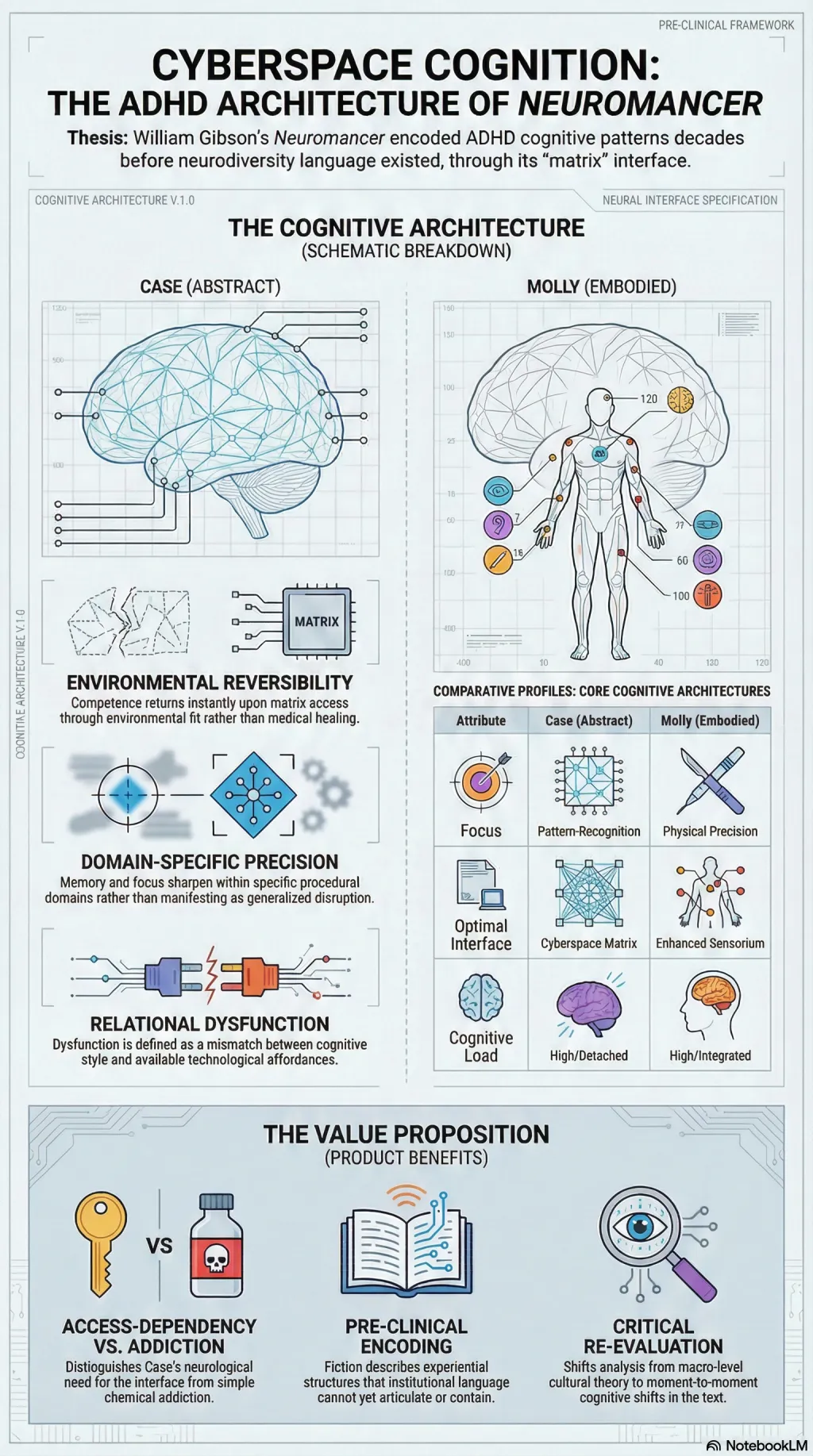
What if Neuromancer wasn’t about addiction? What if it was about ADHD?
In 1984, the DSM-III categorised ADD as a childhood disorder with adult persistence relegated to “residual type.” Neurodiversity as a concept wouldn’t surface for another decade. And yet that same year, William Gibson published a novel that encodes — in extraordinary detail — what it feels like when your cognition depends on an interface that isn’t there.
Before the Words Existed is a scholarly close reading of Neuromancer through the lens of cognitive mismatch. The central argument: Case’s relationship with cyberspace isn’t metaphor, addiction, or noir alienation. It’s a reversible, interface-dependent reconfiguration of attention, memory, and agency that maps precisely onto patterns the field wouldn’t name for years.
The essay tracks three discriminants through the text. Reversibility: Case’s competence returns immediately upon matrix access — not through healing, but through environmental fit. Precision: his memories sharpen specifically within procedural domains, suggesting domain-specific rather than generalised disruption. Relationality: dysfunction originates in the mismatch between cognitive style and available affordances, not in the person alone.
These aren’t retrospective projections. The thesis demonstrates that Gibson’s language preserves an experiential structure the era could feel but not yet articulate — and that the novel circulated that structure across discourse a full decade before the vocabulary solidified.
The analysis extends to Molly as cognitive contrast (her sensorium optimised for embodied precision where Case’s is built for abstract pattern-recognition), to the distinction between chemical addiction and access-dependency (different temporal signatures, different phenomenologies), and to a critical genealogy of cyberpunk scholarship from Jameson through Hayles — showing how macro-level cultural theory operated at a different analytical scale than the moment-to-moment cognitive shifts the novel actually depicts.
A parallel case study traces the same pre-clinical sensor pattern in Philip K. Dick’s work — both authors converting private cognitive experience into interface metaphors, speculative fiction granting permission to describe what institutional language could not yet contain.
Read the Thesis · Download PDF · Evidence Tables · Source on GitHub