Living CV
A self-updating CV pipeline. GitHub Actions runs twice daily, Claude AI refines the content, a hallucination detector gates deployment.
Listen while you read
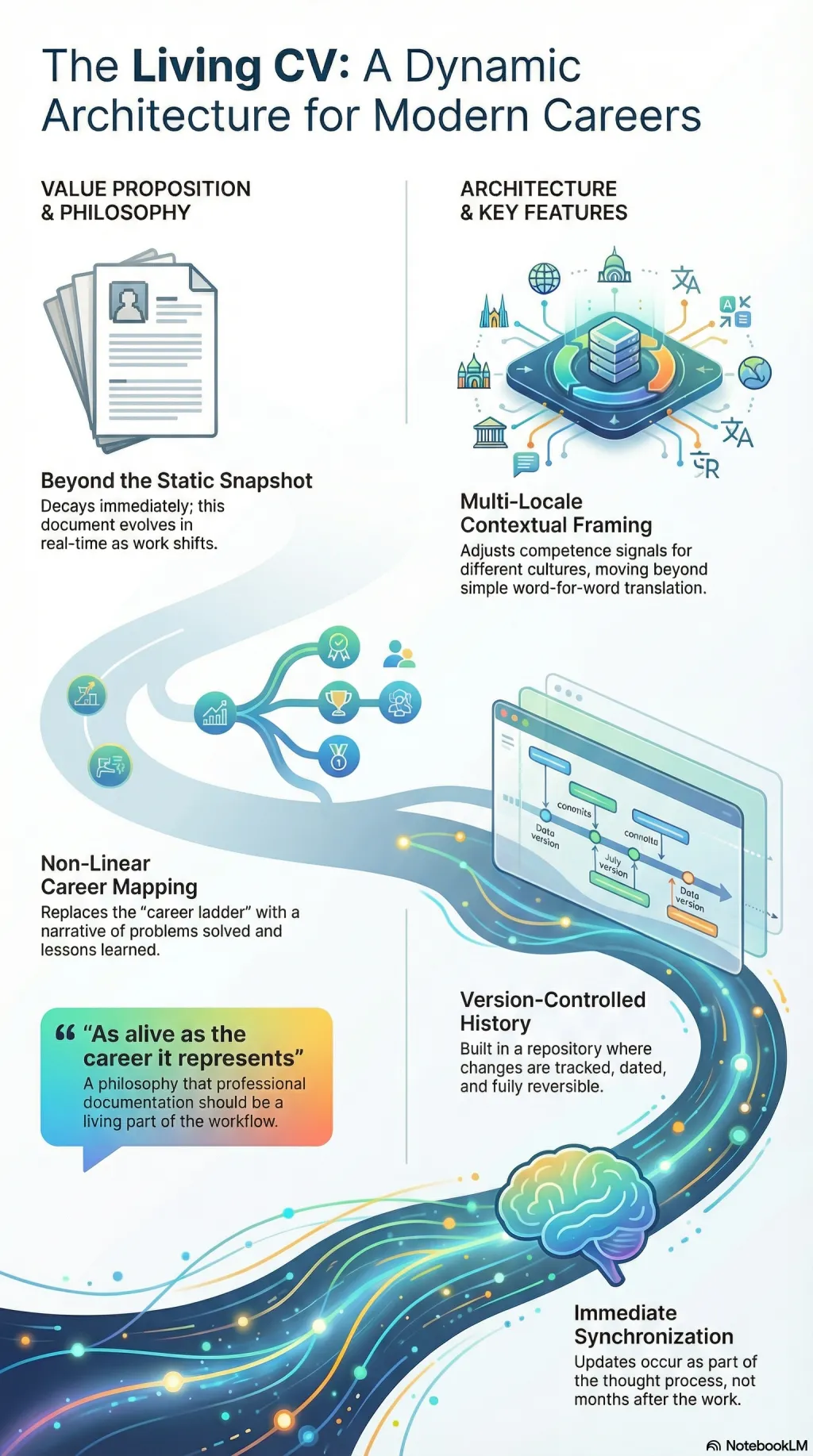
A CV is a strange document. It claims to summarise a career, but the format enforces a lie: that work is linear, that skills accumulate neatly, that the most recent role is the most important one. Every static résumé is a snapshot that begins decaying the moment you export the PDF.
This is not a static résumé. It’s a pipeline.
GitHub Actions runs twice daily. An activity tracker collects real commit data, language statistics, and contribution metrics from the live work. A Claude AI enhancement pipeline processes that data and regenerates the content. Then two gates run before anything deploys: a hallucination detector that validates every claim against actual GitHub metrics, and a content guardian that maintains a registry of verified facts and blocks fabricated ones.
The pipeline won’t ship an invented achievement. Not because it can’t — because it’s been specifically built not to. That constraint is the point. An AI-enhanced CV that could hallucinate its way to impressive claims is not an enhancement. It’s a liability.
The multi-locale architecture matters because translation isn’t just about changing words — it’s about how competence is signalled across cultures. The same experience presented to a Japanese employer needs different emphasis than when presented to an Australian one. Not dishonesty. Contextual framing.
The document lives in version control. Changes are tracked, dated, and reversible. When the work shifts, the CV shifts with it — not in six months when you remember to update a Word file, but on the next scheduled run, as a natural consequence of the work itself.
A professional document should be as alive as the career it represents. And it should be able to prove it isn’t lying.