This Wasn't in the Brochure
A neurodivergent co-parenting guide — what happens when the life you planned meets the brain you actually have.
Listen while you read
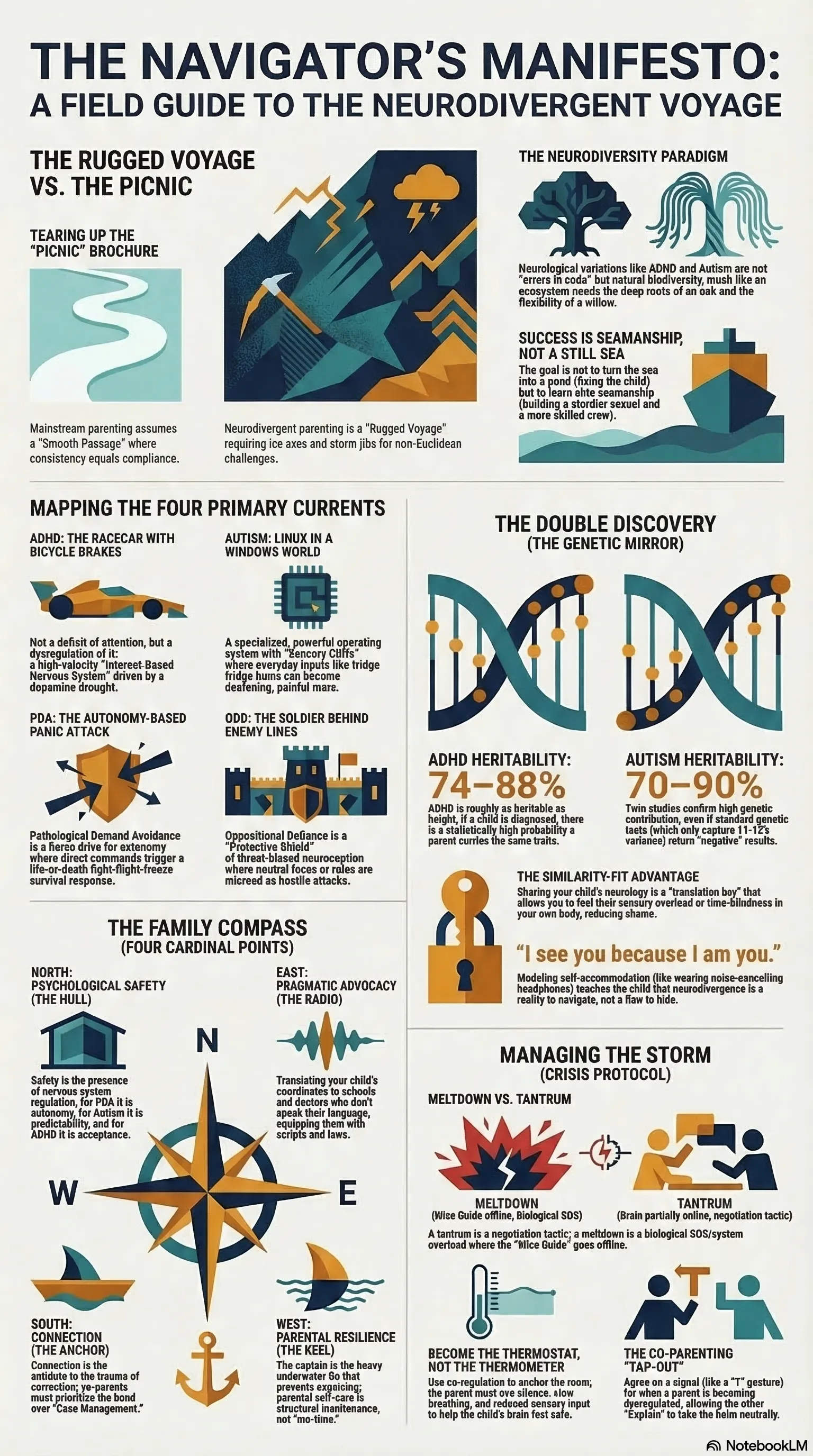
A book and companion site for co-parents navigating ADHD, autism, PDA, and ODD — built on a simple premise: the brochure they gave you was for a different trip.
What it is
Eleven chapters, seven appendices, four regionally localised editions. Not a parenting manual — a cartographer’s guide to the shared neurobiology of your household. The core argument: if your child is neurodivergent, the heritability data (74–90%) means you probably are too. The book calls this the double discovery, and treats it as the foundation of effective co-parenting rather than a complication.
Every strategy includes variations for high-conflict and parallel parenting. You don’t need a friendly divorce to use this book. You need only a shared commitment — even a reluctant one — to your child’s wellbeing.
How it was built
Written using a three-AI cognitive scaffolding workflow: Codex for structural reasoning and evidence synthesis, Claude for voice and narrative refinement, Gemini for adversarial review and gap analysis. The models handled what executive dysfunction made unsustainable — holding the architecture of a 60,000-word manuscript across months of non-linear writing. The authorship is mine. Every argument, every disclosure, every sentence that made me wince and keep it in.
At least 70% of citations are peer-reviewed. The remaining 30% are clinical guidelines, professional consensus documents, and grey literature clearly flagged as such.
The companion site
thiswasntinthebrochure.wtf hosts three free chapters (no email required), a printable survival toolkit (crisis cards, visual routines, scripts for difficult conversations), and regional edition selectors for US, Australian, British, and New Zealand readers — each adapted to local clinical terminology, educational systems, and legal frameworks.
Design
The visual language draws on 16th-century maritime woodcuts: a voyage without reliable charts, navigated by dead reckoning and the willingness to stay on the water. The nautical metaphor runs through the book because mainstream parenting advice is a map for calm water, and your family is sailing open ocean.
Read the full synopsis → · Visit thiswasntinthebrochure.wtf →