The Bottom Pub Co-op
A community proposal to acquire Cygnet’s Commercial Hotel as a co-operative — and the nine things an earlier draft got wrong.
Listen while you read
The Commercial Hotel in Cygnet, Tasmania — the Bottom Pub — has been closed for some time. A community proposal has been circulating: could Cygnet buy it together, as a co-operative?
The question is exactly right. The original proposal, though, made promises it had no business making. What follows is an independent audit — not of the pub, but of the ideas themselves.
The question, not the campaign
This isn’t a campaign. It’s a question: could community ownership work here, and what would it actually take?
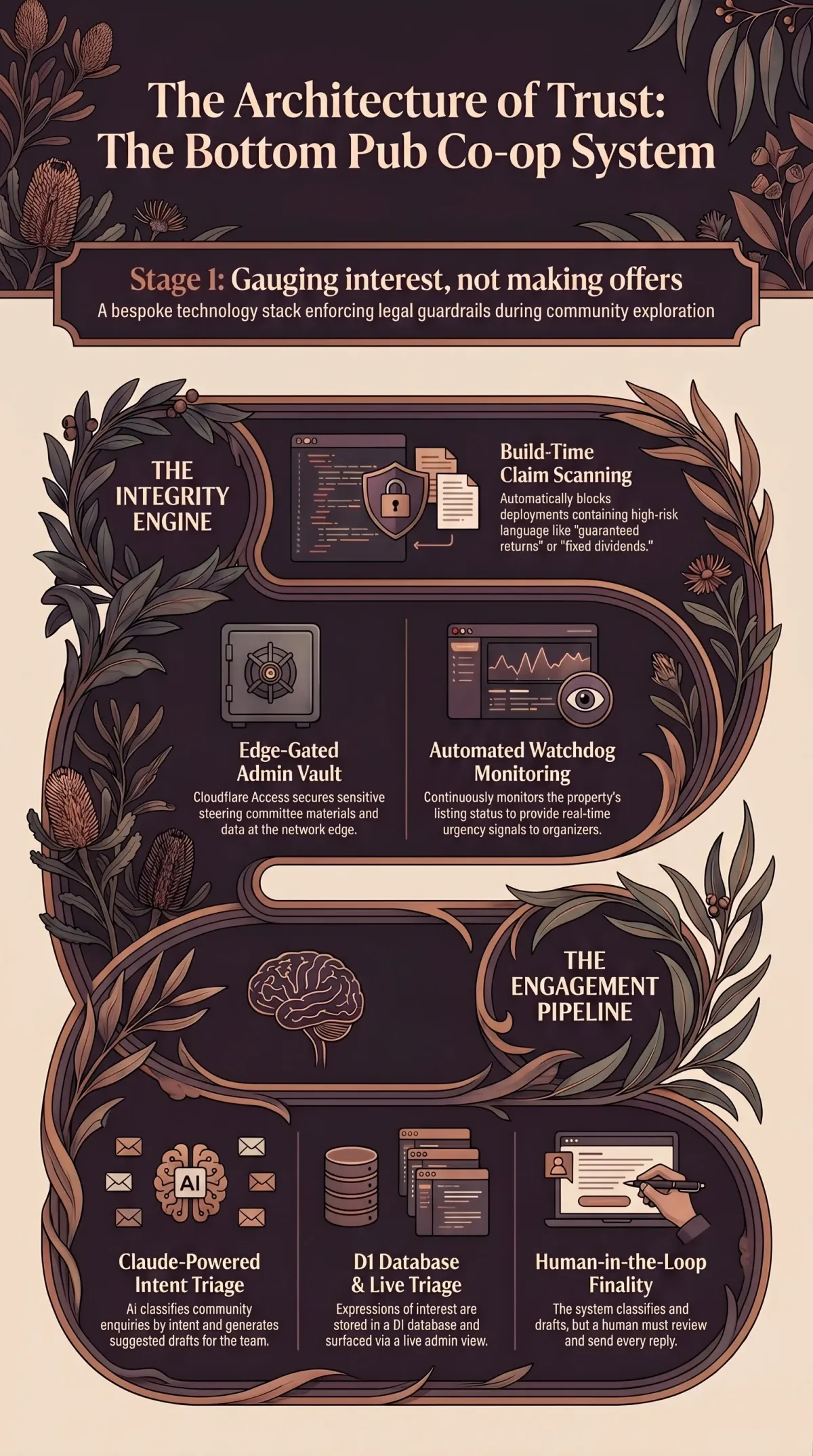
A community expression of interest is open. A public meeting is scheduled for Sunday 17 May at Cygnet Town Hall. The purpose is to gauge whether enough people care to warrant proper feasibility work — nothing more.
How a co-op could work
Subject to legal advice and community input, a co-operative model may allow members to own and govern the enterprise democratically:
- The community owns it. Membership open to eligible locals and supporters; surplus reinvested into the business and community, depending on the structure chosen.
- The board governs it. An elected board, accountable to members. Major decisions reserved for the membership. One member, one vote.
- Professionals run it. Experienced hospitality staff handle day-to-day operations. The pub needs to work as a pub, not as a committee.
- Reporting is open. Transparent financial and governance reporting to members and to the community that supported the project.
None of this is decided. The exact legal structure, membership eligibility, governance rules, and financial model would all need careful work — including advice from co-operative-law and hospitality-licensing professionals — before anything is offered to the community.
Nine things the earlier draft got wrong
An earlier version of this proposal made promises it had no business making and used examples it had not properly checked. Here’s what was stripped out and why.
1. No fixed financial returns. None.
Earlier draft promised 5% annual dividends and a 15-year payback, secured by a first mortgage.
Offering fixed dividends or secured first-mortgage positions to community members would put the proposal into territory regulated by ASIC under the Corporations Act — territory that is not appropriate for an early-stage community proposal, and that would expose members to risks they should not have to underwrite.
2. A co-op cannot hold the liquor licence directly
Tasmanian liquor law (s.22 of the Liquor Licensing Act 1990) requires a licence to be held by a natural person — a publican or licensee, an individual — with a legal relationship to the co-op. The lawful structure is a deliberate split: the co-op owns the business and assets; a publican holds the licence in their own name; a written agreement defines the boundary.
3. Investors don’t get reserved board seats
Australian co-operative law is built on one member, one vote. Reserving board seats by financial contribution, or weighting votes by dollars, would conflict with the core legal definition of a co-operative.
4. Some “case studies” don’t actually apply
Mondragón is a multi-billion-euro Spanish industrial federation. The Old Crown’s situation differs in scale, jurisdiction, and trading history. Case studies will only be put forward once they’ve been properly verified by someone with no stake in the idea.
5. “Forever” overstates the asset lock
A non-distributing co-op under the Co-operatives National Law has a real asset lock — surplus stays in the enterprise — but the co-op can still be wound up under specific procedures. The honest commitment is “the rules can be drafted to make selling out very hard, on community terms” — not “forever.”
6. Membership isn’t a one-off donation
The Co-operatives National Law requires every co-op to have an active-membership rule (SMART: Simple, Measurable, Actionable, Reasonable, Timely). A member who stops meeting the test legally loses their membership. “Pay once and you’re in forever” would not satisfy the Registrar.
7. Sociocracy isn’t the right shape for a single-venue startup
Imposing a multi-stakeholder sociocratic governance model on a single-venue rural pub before it has traded a single day risks administrative paralysis at exactly the moment the business needs decisive operational leadership. A small elected board, a clear board-vs-management split, and a professional general manager is the right starting shape.
8. There is no Year-5 surplus to pre-allocate
Regional Australian hospitality is brutal in years 1–3; survival is the only goal. Distributing percentages of imaginary surplus to specific causes before a single trading year is financially reckless. Surplus-treatment policy is a board-and-member decision after trading proves it’s possible, not a marketing line at Stage 1.
9. Volunteers don’t run a commercial pub
Working bees, opening events, and ad-hoc community-asset maintenance — fine. Volunteer hours substituting for paid labour in a commercial hospitality operation is a Fair Work Act 2009 and workers-compensation risk. Misclassifying an employee as a volunteer carries civil penalties under ss.357–359.
What we don’t know yet
Some questions are genuinely open. Others have answers in legislation.
- The building. The Commercial Hotel is privately owned, closed, and not publicly listed for sale. The right posture at Stage 1 is to express community interest openly so that if the building’s future is ever up for discussion, a community-ownership option is on the table.
- Purchase price and condition. Both unknown. A proper independent valuation and building condition report would be required before any decision.
- Heritage constraints. The building dates to 1885 and is subject to heritage protections that will impact renovation costs and scope.
The staged path forward
- Interest — gauge community appetite (this is where we are)
- Steering — form a steering committee
- Feasibility — commission professional feasibility study
- Form co-op — register and incorporate
- Decide — community vote on whether to proceed
If a future version of this proposal slips back into any of the nine mistakes above, point at this page and ask why.
Full briefings and sourced cross-walks are at bottom.pub.