The Button Was Never the Art
AI can produce slop. But when provenance replaces criticism, we stop judging the work and start policing who is allowed to make art.
Listen while you read · 22:10
Apparently we have solved art.
After several thousand years of arguing about beauty, authorship, intention, craft, originality, appropriation, photography, conceptual art, sampling, found objects, performance and whether a urinal can be sculpture, we have finally discovered the objective test:
Did an AI touch it?
If yes: slop.
I see this constantly now. Someone posts an image and, almost immediately, somebody announces that it is “AI slop.”
Sometimes they’re right.
There is an astonishing amount of AI slop.
There is also an astonishing amount of human slop.
The internet was not exactly a pristine gallery of considered artistic expression until generative AI came along and shat in the reflecting pool.
What generative AI has changed is the economics. It is now possible to produce mediocre cultural material at extraordinary speed. One person can manufacture a thousand competent-looking images in an afternoon, upload them everywhere and move on to generating a thousand more.
That’s a real problem. “Slop” is a pretty good word for it.
But somewhere along the way, a useful criticism of mass-produced, low-intent content mutated into a judgement about provenance.
AI can produce slop.
Therefore AI images are slop.
Therefore using AI is cheating.
Therefore what you made isn’t really yours.
Therefore you aren’t really an artist.
At that point, “slop” has stopped describing the work at all.
We’ve been here before.
You just pushed a button
When photography appeared in the nineteenth century, it destabilised some very old assumptions about art.
Here was a machine that could produce an extraordinarily detailed representation of the world without somebody spending three weeks standing in front of an easel.
You just operated the machine.
You just pushed the button.
What sort of artist does that make you?
It turns out: potentially, a photographer.
Eventually we developed a vocabulary sophisticated enough to understand that operating a camera and making a photograph aren’t quite the same thing.
Composition matters. Timing matters. Lighting matters. Selection matters. Staging matters. Processing matters. Printing matters. Context matters.
Most importantly, the person behind the machine matters.
The button was never the art.
We went through versions of the same argument with electronic music.
A synthesizer wasn’t a “real instrument.” A drum machine wasn’t a drummer. Sequencers were cheating. Sampling was stealing. DJs weren’t musicians. Computers were doing the work.
Then people got their hands on those supposedly fake instruments and made sounds that had never existed before.
Not despite the technology.
Because of it.
The interesting artists didn’t spend their lives trying to prove that a synthesizer was secretly a violin.
They twisted knobs until the machine screamed.
That’s what artists do.
The verb is the problem
This is where conversations about AI become stupid, because everyone is apparently required to join one of two religions.
Either generative AI is the glorious democratisation of human creativity and anyone who objects is a Luddite, or it is an industrial plagiarism machine and anyone who uses it is therefore creatively bankrupt.
I don’t want either church.
There are serious questions about how these systems were trained, whose work was used, who gets paid, who loses work, who owns the infrastructure and what happens when the cost of manufacturing plausible cultural material approaches zero.
Those aren’t imaginary problems.
And generative AI is not simply photography again.
Cameras were not built by ingesting millions of painters’ canvases. Synthesizers did not arrive carrying unresolved questions about consent, attribution and compensation at this scale.
Those differences matter.
But they still don’t establish that no artist can make art with the resulting technology.
A medium can have ugly economics, contested provenance and extraordinary artistic possibilities at the same time.
We have managed that contradiction before.
And none of this requires pretending that every use of the technology is profound.
There is plenty of this:
beautiful cyberpunk woman, neon rain, cinematic, 8k, masterpiece
Generate.
Generate.
Generate.
Upload.
If that’s the entire creative process, I’m not especially interested in pretending we’ve witnessed the birth of a new Rembrandt.
But imagine somebody else spends three weeks making a single image.
They photograph their own materials. Generate hundreds of variations. Discover something strange in the model’s failures. Change the prompt. Change the model. Feed the results back through another process. Composite fragments. Paint over them. Throw almost everything away. Print the survivors. Hate them. Go back. Break something deliberately. Eventually produce one image that says exactly what they wanted it to say.
We describe both people with the same verb:
prompting.
That’s absurd.
It’s like describing both a tourist taking a selfie and a photographic artist as “pressing a button.”
Technically true.
Almost completely useless.
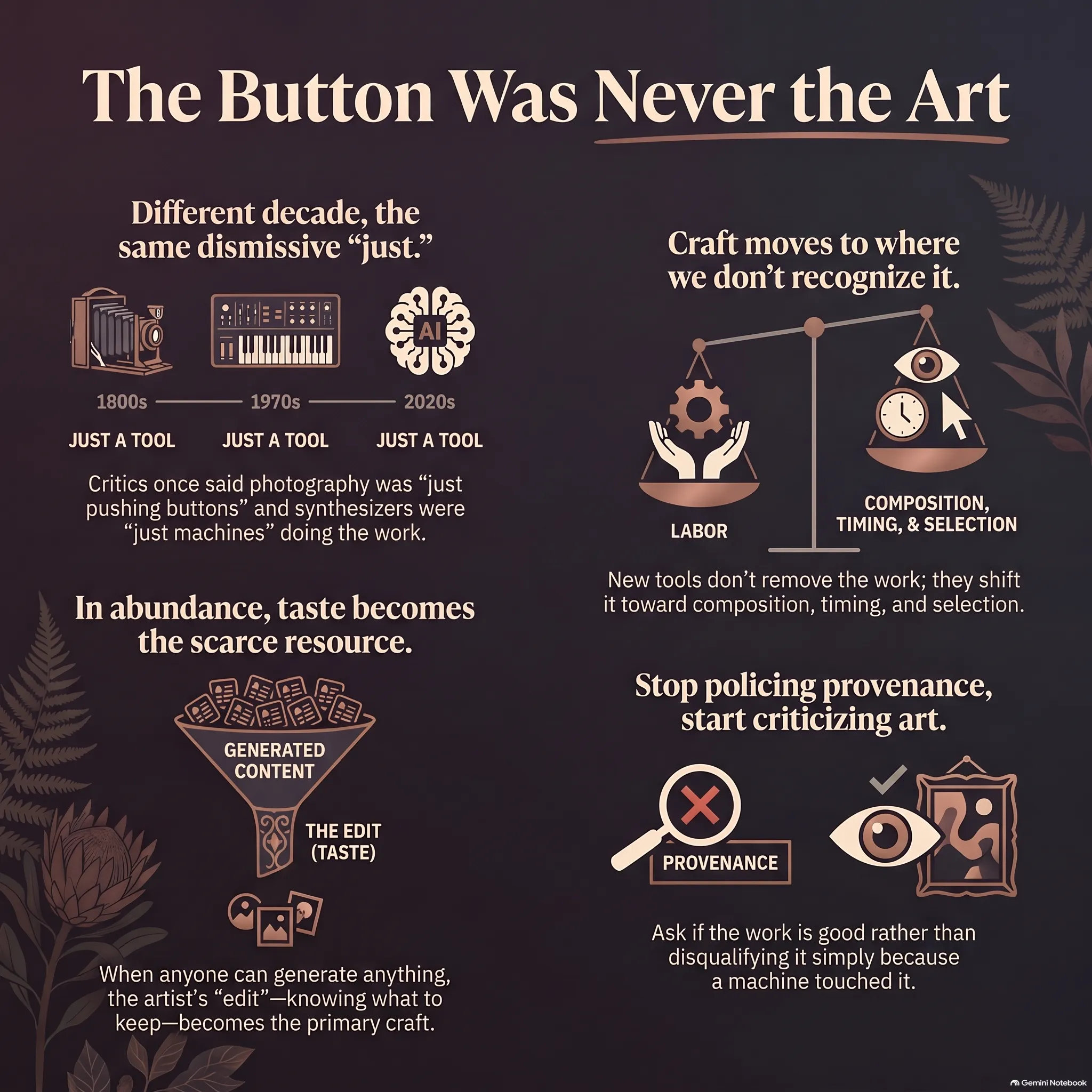
Different decade. Same “just”.
Maybe this gets under my skin because I’ve heard versions of it for most of my creative life.
I was a DJ.
Apparently I was just playing other people’s records.
I made electronic music.
Apparently the machines were doing the interesting part.
I started playing with Photoshop as soon as I could get my hands on it, at a time when I remember “Photoshopped” itself becoming another word for fake.
Digital art wasn’t quite real art either.
Now I spend an unreasonable amount of time somewhere in the mess between art, code, science, machines and whatever the hell else I’m doing with multimodal AI.
I hate “vibe coding” for much the same reason. It describes a real failure mode: handing judgement to the machine and shipping whatever comes back. But increasingly it’s thrown at almost any AI-assisted programming, collapsing reckless autocomplete and careful architecture, experimentation, review and verification into the same dismissive “just”. Once again, the presence of the tool is treated as evidence that the human contribution disappeared.
And here it is again.
The tool is doing it.
You aren’t really making anything.
You’re not really an artist.
Maybe that last one lands harder than it should because some part of me has spent most of my life believing it.
I’ve never been particularly comfortable calling myself an artist. DJ, programmer, photographer, tinkerer, whatever. There was always some safer noun available. Imposter syndrome is wonderfully efficient at finding the least flattering explanation for anything you make.
So perhaps I recognise this argument because I’ve internalised it before.
But after hearing the same accusation attached to enough successive technologies, I’m starting to suspect the problem might not be the fucking tools.
There is a recurring cultural instinct to mistake unfamiliar mediation for absence of authorship.
New tools don’t necessarily remove the work. They move it somewhere people haven’t learned to recognise as work yet.
If we can’t see the craft — or the craft doesn’t resemble the one we learned to respect — we assume there isn’t any.
You’re just playing records.
You’re just manipulating pixels.
You’re just pushing buttons.
You’re just prompting.
Different decade.
Same “just”.
Brushes are getting weird
I wonder about the artists working with these systems now.
Not the content farms pumping out 400 pictures of Jesus made from prawns.
The weird ones.
The people treating generative models as one brush among several. The painters using them for composition. Filmmakers creating shots they could never afford to produce conventionally. Musicians pulling sounds out of models and mangling them beyond recognition. Programmers building their own generative systems. Artists deliberately exploring hallucination, latent space, machine perception and failure.
Somebody, somewhere, is currently doing something genuinely new with this technology.
And we’re probably telling them it’s slop.
There is another cost to that reflex.
“AI slop” increasingly isn’t just a description of work. It’s becoming a permission structure for contempt.
Once the presence of AI is treated as proof that the work is fraudulent, lazy or artistically illegitimate, people stop criticising the thing in front of them and start judging the person who made it.
The artist becomes fair game for ridicule simply for admitting that a generative model was somewhere in the process — and sometimes even when it wasn’t, because people are now confidently misidentifying human-made work as AI and abusing the artist anyway.
That’s a rotten cultural norm to build.
An artist should be able to say, plainly, yes, I used AI here, without that functioning as a confession.
There’s a particularly stupid consequence to making that disclosure socially punishable.
People learn not to disclose it.
The culture demanding transparency about AI use simultaneously creates an incentive to hide it.
If provenance matters, honesty about process has to be safer than pretending the process never happened.
You can dislike the tool. You can question the ethics of the model. You can hate the result.
But if your entire critical vocabulary is “slop” the moment you think you know how something was made, you aren’t defending art.
You’re policing who’s allowed to make things.
And where, exactly, is that boundary now?
Is generative fill disqualifying? Automatic masking? AI denoising? Upscaling? Frame interpolation? Source separation? A generated reference image that never appears in the finished work?
How much AI has to touch something before the artist disappears?
Five pixels?
Fifty per cent?
The distinctions between those uses can matter enormously. But “AI touched it” tells us almost nothing about them.
The binary is already breaking down under the weight of how people actually make things.
What are these things actually for?
Artistic tools don’t merely make existing art easier to produce.
Sometimes they create entirely new artistic languages.
Early photography borrowed heavily from painting.
Early synthesizers imitated existing instruments.
Early websites looked like pages.
New media often spend their adolescence impersonating old media before somebody works out what they’re actually good at.
Generative AI feels extremely adolescent.
We’re still mostly asking it to make paintings, photographs, songs and films.
Those are categories we already understand.
The really interesting question is what happens when artists stop asking generative systems to imitate old media and start discovering things that couldn’t exist without them.
And perhaps authorship itself gets stranger.
Artists have never had to personally execute every physical action involved in making art. Directors don’t operate every camera. Architects don’t lay every brick. Artists have worked with assistants, fabricators, performers, chance, instructions, found objects and machines for a very long time.
Generative systems complicate authorship in new ways.
Good.
Complicated questions are more interesting than pretending the question has already been answered.
When a machine can propose almost unlimited possibilities, perhaps generation itself isn’t even the scarce part anymore.
Judgement might be.
Knowing what to ask for. Knowing what to keep. Knowing what to throw away. Recognising the strange accident worth following. Building a process that produces interesting failures. Knowing when something is finished.
When almost anything can be generated, taste becomes expensive.
Abundance doesn’t abolish craft. It changes which craft is scarce.
I don’t know what the genuinely native art forms of generative AI will look like.
That’s why they’re interesting.
Then criticise the art
None of this means we have to admire something because AI was involved.
Quite the opposite.
Criticise it.
Ask where the training data came from.
Ask what the artist actually contributed.
Ask whether the process is interesting.
Ask whether the work says anything.
Ask whether the technology is essential to it or merely convenient.
Ask whether somebody has transformed their materials or simply accepted the first thing a model spat back.
And then ask the most important question:
Is it any fucking good?
That’s a much harder question than checking whether an image contains six fingers and typing “AI slop.”
It requires looking at the work.
The brush doesn’t answer it for us.
Not sable hair.
Not a camera.
Not a turntable.
Not an oscillator.
Not Photoshop.
Not a diffusion model.
And not whatever ridiculous thing we’re making art with next Thursday.
There will be oceans of AI slop.
There already are.
But somewhere in that ocean are people abusing these strange new machines, misunderstanding them, modifying them, combining them with older tools and pushing them into places their creators never anticipated.
Twenty years from now, I suspect we’ll recognise some of them as pioneers.
And some poor bastard will still be in the comments saying they just pushed a button.
The button was never the art.
Explore
Video summary
Infographic