The Resonant Fringe
Auditory Spiral, RTRFM, and how Perth's electronic music underground was built on overnight radio, borrowed turntables, and cassette tapes.
Listen while you read
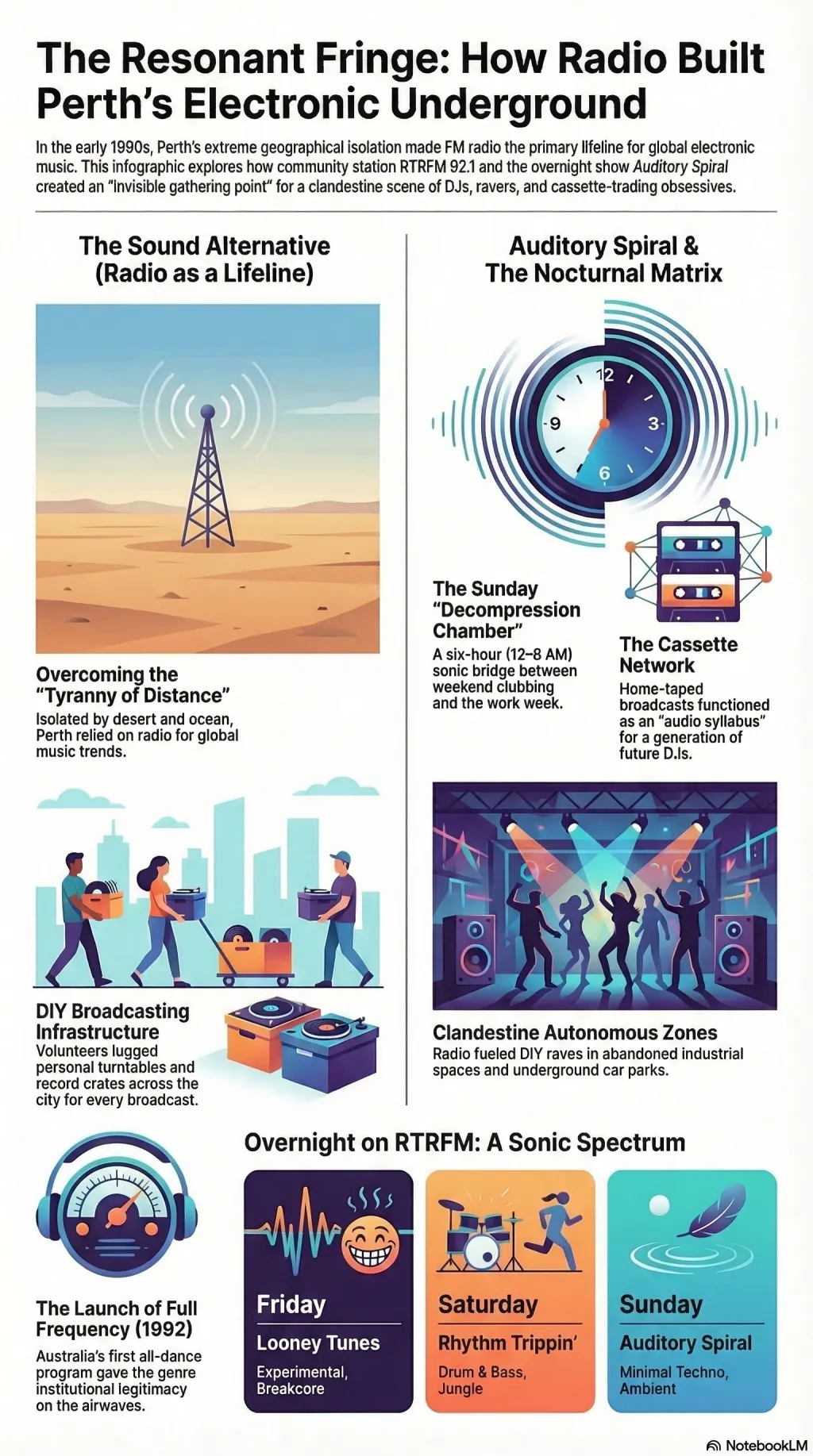
In the early 1990s, if you wanted to hear Detroit techno in Perth, you had two options: find someone who’d imported the vinyl, or stay up past midnight on a Sunday and tune your FM dial to 92.1.
I did both.
The tyranny of distance
Perth’s geographical isolation shaped everything about its music scene. Separated from the rest of Australia by desert and from the rest of the world by ocean, the city’s electronic music community couldn’t rely on touring DJs, well-stocked import bins, or proximity to anything. Vinyl had to be pressed overseas, shipped by freight, and distributed through a handful of specialist record shops. Before broadband, before Discogs, before Spotify — the radio was the lifeline.
And the radio, specifically, was RTRFM 92.1.
Founded on 1 April 1977 as 6UWA (later 6UVS), the station was Western Australia’s first FM stereo broadcaster. It eventually adopted the tagline “The Sound Alternative” — not as marketing, but as mission statement. RTRFM existed to platform music that commercial radio actively excluded.
In the late 1980s and early 1990s, the station’s survival depended almost entirely on the dedication of unpaid volunteer presenters. The studios had no permanent DJ equipment. If you wanted to do a mix show, you carried your own turntables, your own mixer, and your own crates of records across the city to the studio, assembled a temporary club setup in a radio booth, and broke it all down again at 6 AM.
The fight for the airwaves
Electronic music didn’t walk into RTRFM unopposed. It had to fight for every timeslot.
In the early 1990s, presenters Adil Bux and Ben Stinga managed to get electronic music into the coveted Drivetime slot — a radical move that put synthetic, repetitive beats where rock and talk radio were supposed to be. When station management changed, the genre was promptly demoted to a weekend evening slot, rebranded as Strictly Rhythm and later Underground Solution.
Bux and Robert Fletcher lobbied hard against the decision. Their advocacy led to a landmark outcome: the creation of Full Frequency, which launched in January 1992 as the first all-dance-music program on Australian radio. It ran for over 25 years, celebrating its silver anniversary in 2017 with a massive event at Ambar nightclub featuring Dan the Man, Rok Riley, Micah, Saxon, James A, Craig Hollywood, and Will Backler.
Full Frequency gave electronic music institutional legitimacy within the station. It also provided cover for the overnight shows to push further into the experimental margins — shows like ours.
Auditory Spiral
Auditory Spiral aired Sunday nights into Monday mornings, midnight to 6 AM. Six hours of uninterrupted electronic music in the deepest, most isolating hours of the week.
Commercial broadcasters call the overnight slot “dead air.” For us, it was the opposite — a zone of absolute creative freedom where the constraints of daytime formatting simply didn’t apply. No need for broad demographic appeal. No pressure to keep things accessible. Just six hours to let a twelve-minute instrumental track slowly unfold without interruption.
The show belonged to Shamus and Nicolai. DJ Shamus (Shane) was the architect — he built the signature aesthetic that listeners consistently described as “deep and dark.” Shamus took the Monday 12–6 AM shifts and constructed hypnotic, continuous journeys through minimal techno, dark ambient, early Detroit techno, and European acid. He had an extraordinary ear for pacing a six-hour broadcast, knowing exactly when to drop the floor out and when to let a groove build for twenty minutes without touching the mixer.
Nicolai brought a different sensibility — broader, more willing to follow a tangent into unfamiliar territory. Between the two of them, they defined what the show was. Roger helped maintain the demanding overnight schedule, and together they created something that was genuinely unlike anything else on the dial.
I was lucky enough to present on the show for several years, and the experience shaped how I think about curation, community, and the value of making space for difficult music. But Auditory Spiral was Shamus and Nicolai’s creation. I came to it the way most people came to everything in that scene — through the gigs, through the dancefloor, through friendships built at 3 AM in warehouses where nobody checked your credentials. That porousness was the point.
The Sunday night decompression chamber
The timeslot wasn’t accidental. Sunday night is the terminus of weekend club culture. The venues close, the energy dissipates, and the city goes quiet. For the people who weren’t ready for that transition — ravers extending the weekend, shift workers navigating the urban emptiness, insomniacs, obsessives — Auditory Spiral was the decompression chamber.
Listeners knew that across the sprawling suburbs, hundreds of others were tuned to the same frequency. It was an invisible gathering point, a localised electronic hearth connected only by FM radio waves.
Warehouse raves and car park parties
The music we broadcast was the sonic lifeblood of a clandestine subculture. Commercial nightclubs often rejected the aggressive BPMs and synthetic textures of pure techno, so the community built its own autonomous zones. Abandoned industrial spaces. Improvised venues. One famously surreal event was a Star Wars-themed rave held seven floors underground in the depths of a Wilson car park.
The rave philosophy of P.L.U.R. (Peace, Love, Unity, Respect) genuinely permeated the Perth underground. The dress code prioritised endurance over aesthetics: excessively baggy jeans and oversized T-shirts across all genders. Cult brands like “Non-Issue” jeans — identifiable by the small stitched emblem of a dancing techno figure on the back pocket — became markers of subcultural belonging.
Auditory Spiral was inextricable from this environment. We were the marketing channel, the post-party soundtrack, and the educational hub.
The cassette network
The tracks we played were largely obscure white-label imports, exclusive dubplates, or limited European pressings — virtually impossible to buy in Perth. So the listeners taped them.
Sitting by the stereo with a blank cassette queued up, hitting record the moment a compelling beat emerged from the static. These home-recorded tapes became prized artefacts: dubbed, traded, carefully labelled, and circulated through schools, record shops, and subversive clothing outlets. The car stereo became a mobile extension of the warehouse, and the cassette tape gave our ephemeral overnight broadcasts a kind of localised permanence.
This analogue archiving had a profound pedagogical effect. The overnight broadcasts functioned as an open-source audio syllabus, teaching a generation of future DJs, promoters, and producers the structures, tempos, and textures of international dance music.
The nocturnal matrix
Auditory Spiral wasn’t an isolated anomaly. It was the Sunday/Monday anchor in a station-wide commitment to overnight electronic programming. During the late 1990s and early 2000s, RTRFM had effectively monopolised underground dance music discourse in Western Australia:
| Night | Programme | Timeslot | Presenter(s) | Sound |
|---|---|---|---|---|
| Thursday → Friday | Beats Per Minute | 1–6 AM | Colin Bridges | Acid trance, French disco, European imports, camp anthems |
| Friday → Saturday | Looney Tunes | Overnight | Various | Experimental electronic, breakcore, nascent sub-genres |
| Saturday → Sunday | Rhythm Trippin | 2–6 AM | Various | Drum and bass, jungle, breakbeat, sound system culture |
| Sunday → Monday | Auditory Spiral | 12–6 AM | DJ Shamus, Nicolai, Roger | Minimal techno, industrial, atmospheric, long-form mixing |
| Variable | Difficult Listening | Overnight | Various | Avant-garde, noise, electro-acoustic, pure experimentation |
Each night offered a distinctly different acoustic environment tailored to the psychological flow of the weekend.
The signal persists
Auditory Spiral is more than an archival footnote. In a geographically isolated city, during an era defined by the physical constraints of analogue media, the programme functioned as a trans-hemispheric bridge linking Perth to the global vanguard of techno and experimental sound.
We fostered connections with the illicit warehouse scene. We fuelled a peer-to-peer cassette network. We educated a generation of future broadcasters and music industry professionals. And we did it from midnight to dawn on a community radio station, carrying our own turntables, playing records that most of the city would never hear any other way.
The most profound cultural movements are often broadcast at the extreme margins of the dial, in the quietest hours of the night. Perth’s electronic music underground is proof.
View the Auditory Spiral project page →
Sources: X-Press Magazine, RTRFM Wikipedia, r/perth