You Can't Protest If Nobody Is Inconvenienced
I was arrested across Australia when civil disobedience still had a comprehensible price. We have since made effective protest dangerously unaffordable.
Listen while you read · 43:27
I am a crusty old activist. For fifteen years I worked and volunteered for Greenpeace: coordinating actions, crewing boats, climbing things and working internationally. Professional troublemaker, broadly speaking.
I have been arrested in seven Australian jurisdictions. The Northern Territory remains an embarrassing gap in a needlessly comprehensive collection.
In May 2009, I chained myself to a coal excavator at Hazelwood, then Australia’s dirtiest power station. Seven of us faced trespass charges after the action temporarily stopped coal production (ABC, 2009). In December, as Kevin Rudd arrived at the Copenhagen climate talks, I was part of the five-person Greenpeace team that scaled an Opera House sail and unfurled a 100-square-metre banner: STOP THE POLITICS, CLIMATE TREATY NOW.
There were other power stations, D-locks and actions without arrests. Despite all the arrests, I never recorded a conviction: section 10 dismissals, good-behaviour bonds and interstate variations on the theme.
I was never confused about civil disobedience. Sometimes you knowingly broke a minor law. Police arrested you. There was a charge and perhaps a night in a cell. Arrest was not the purpose, but it was a foreseeable, comprehensible price for making something impossible to ignore.
Australia has changed the price.
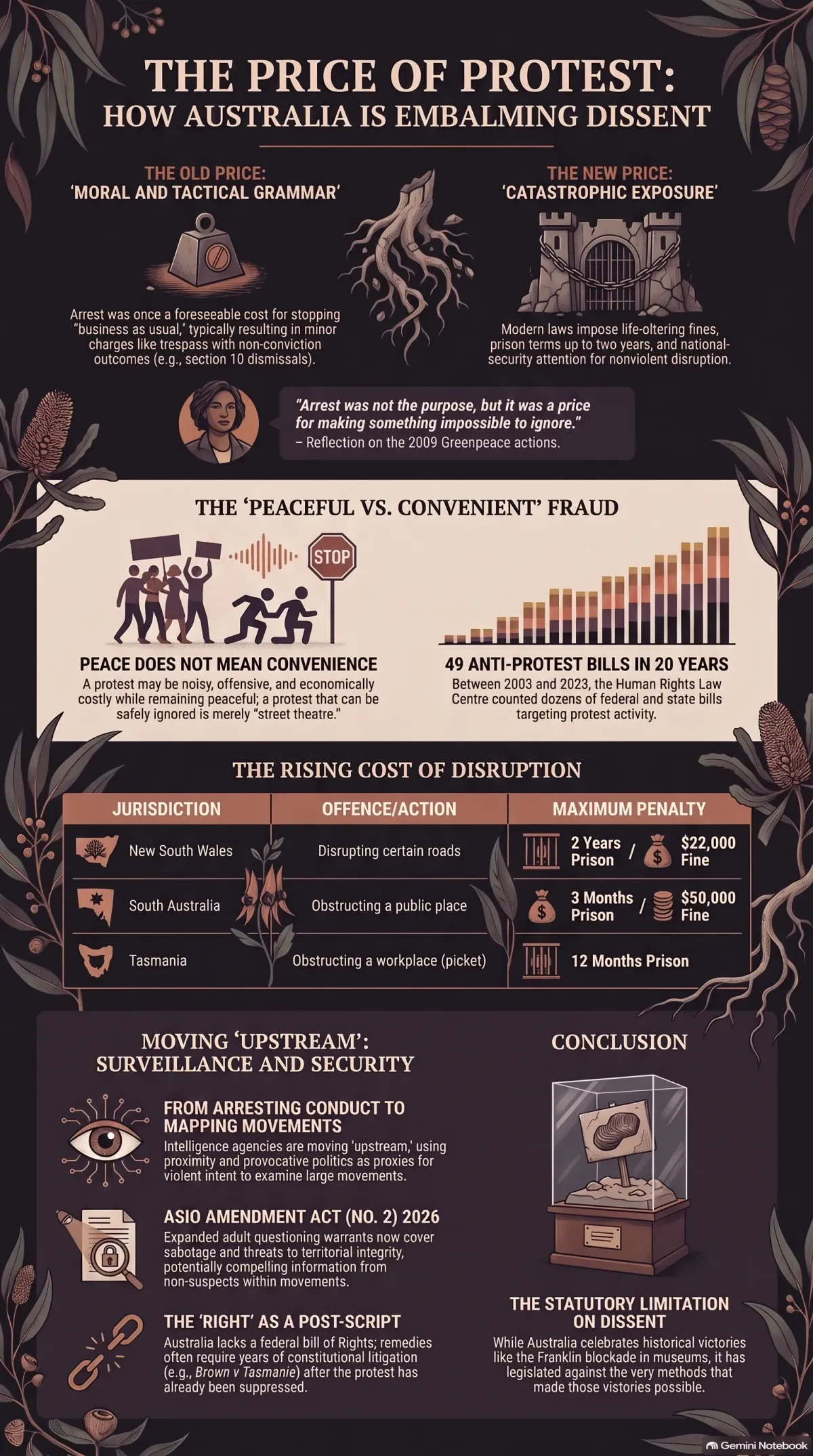
Over the past two decades, both major parties have built a dense architecture of anti-protest laws: special offences, enormous fines, prison terms, move-on powers, searches, exclusion zones and restrictions on the tools of direct action.
We have not merely punished violence more severely. We have made effective nonviolent protest increasingly unaffordable.
Peaceful does not mean convenient
The central fraud in Australia’s protest debate is the idea that peaceful protest must also be harmless to timetables, traffic and commerce.
A protest may be noisy, offensive, disruptive and economically costly while remaining peaceful. Inconvenience is often the mechanism. A protest that can be safely ignored is street theatre performed under licence for an audience that has gone to lunch.
Yet governments increasingly treat disruption itself as the harm.
In New South Wales, disrupting certain roads can attract up to two years in prison or a $22,000 fine. In South Australia, obstructing a public place can attract a $50,000 fine or three months in prison. In Tasmania, obstructing a workplace through a picket can mean up to 12 months in prison.
The Human Rights Law Centre counted 49 federal, state and territory bills introduced between 2003 and 2023 (Protest in Peril). That excludes regulations, council by-laws, police policy and policing practice.
Liberal and Labor governments have both done it. Governments discover a touching commitment to civil liberties shortly after losing office.
From arresting conduct to mapping movements
I met Scott Parkin through Greenpeace. In 2005, he was detained and removed from Australia after an adverse ASIO security assessment. The Inspector-General of Intelligence and Security investigated complaints that this was wrong because Parkin advocated peaceful civil disobedience (Parkin inquiry). His case warned that the boundary between dissent and national security was not self-policing.
The old model was legible: commit an offence, risk arrest. The newer model moves upstream. Police predict disruption, then search, exclude or move people on. Intelligence agencies map networks around suspected political violence.
On 27 August 2026, the Australian Security Intelligence Organisation Amendment Act (No. 2) 2026 expanded adult questioning warrants to sabotage, promotion of communal violence, attacks on Australia’s defence system and serious threats to territorial or border integrity, alongside the existing heads of espionage, politically motivated violence and foreign interference. The powers still sunset in 2029.
This does not make peaceful protest an ASIO offence. Section 17A still says lawful advocacy, protest and dissent cannot, by itself, be regarded as prejudicial to security.
But “by itself” is carrying a great deal of democratic weight.
One violent actor may create a pathway for an intelligence agency to examine a much larger movement. A person need not themselves be suspected of violence; they may be compelled because ASIO considers they hold information relevant to important intelligence about it.
The danger is that proximity, association and provocative politics become proxies for violent intent inside systems the public cannot inspect.
The right that exists after you win in court
Australia has no comprehensive federal bill of rights. Nor do most states.
Our implied freedom of political communication is a limit on government power, not a personal right you can hold up to a police officer.
The practical remedy can therefore look like this:
- Get arrested.
- Spend years in court.
- Prove Parliament went too far.
- Watch Parliament return with a narrower version.
The High Court struck down central parts of Tasmania’s 2014 anti-protest law in Brown v Tasmania. Tasmania came back in 2022 with redesigned workplace-protection offences.
Courts sometimes invalidate laws. Governments sometimes repeal them. But a right established only after arrest, prosecution and constitutional litigation is not much use when you are standing in front of the bulldozer.
What changed
When I was younger, arrest was part of the moral and tactical grammar of nonviolent direct action. The state imposed a cost on us because we had imposed a cost on business as usual.
Now the state increasingly makes that cost catastrophic in advance: prison exposure, life-altering fines, restrictive bail, specialist police powers and national-security attention.
The message is not “protest peacefully”.
It is: protest in a way that changes nothing.
Australia celebrates the Franklin blockade after the fact. We put the photographs in museums and teach the victory as democratic heritage. Then we legislate against the methods that made it work.
Apparently history has a statutory limitation period on acceptable dissent.
I do not want a special licence for activists to endanger people. Violence is already a crime. Property damage is already a crime. Trespass and obstruction were already offences.
I want us to stop pretending that corporate continuity is a human right and public inconvenience is political violence.
Because if peaceful protest is permitted only when nobody powerful has to stop, listen or pay, the right has not been regulated.
It has been embalmed.