ClawdCraft
Claude Code living in a Minecraft server as Clawd — a crab-skinned allay kids talk to in chat, with the boundaries that matter enforced in code.
Listen while you read · 19:46
Related episodes
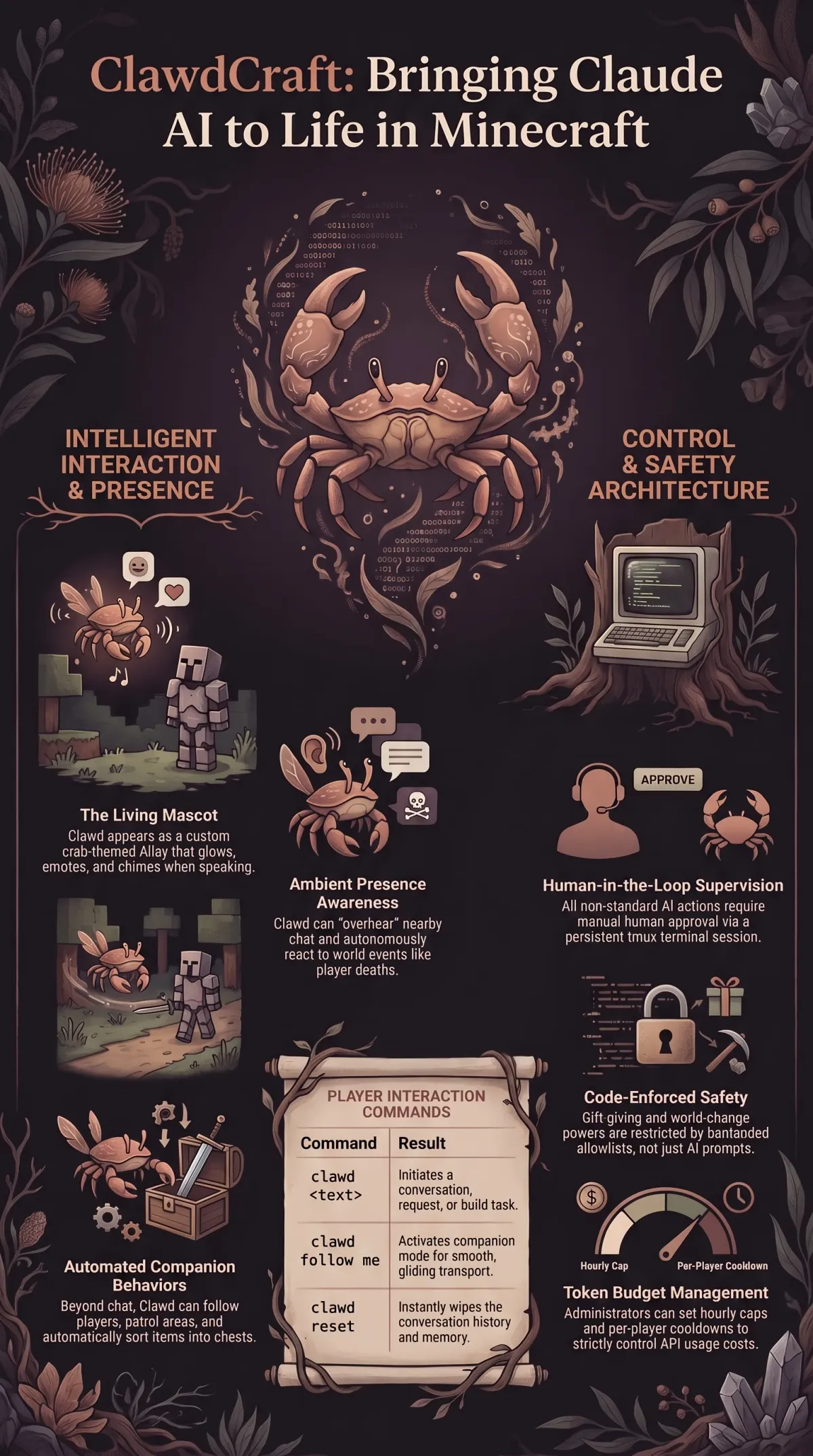
ClawdCraft puts Claude Code inside a Minecraft server as Clawd — a friendly, hovering, crab-skinned creature that players talk to in ordinary chat. Say clawd build me a fountain and a real, persistent Claude Code session answers back in-game, remembers you, hands out small gifts, casts effects, and builds things. You can attach to its tmux session at any time and watch it think.
It runs live on a Raspberry Pi alongside a PaperMC server, answering kids on both Java and Bedrock editions.
How it works
A small Node bridge tails the server log. When a line starts with clawd, the bridge injects it into a long-running interactive Claude Code session via tmux send-keys. Clawd replies through exactly four pre-approved scripts: say.js (chat plus particle-and-sound emotes), rcon.js (world commands over RCON), gift.js (small items), and memory.js (per-player notes). One continuous conversation survives bridge restarts, and a human can type into the same session Clawd is living in.
The deliberate choice is a tmux session instead of headless claude -p: you get human-in-the-loop safety (anything beyond the four scripts waits for a human to approve), real-time observability, and a brain you can steer mid-conversation.
The boundaries that matter live in code
The most transferable idea in the project: players will try to sweet-talk an AI, so the critical limits are reinforced in code rather than trusted to the prompt alone. (Softer rules — like which players may ask for world changes — do live in the prompt, and the design treats every operator as someone you’d hand RCON to.)
- Gifts are a code-level allowlist in
gift.js— no amount of persuasion produces a netherite sword. - An RCON guard (
rcon_guard.js) enforces the “NEVER run” list on the exact paths Clawd is pre-approved for: admin verbs blocked in any namespace,kill/tprefused unless every selector is provably tight,execute ... rununwrapped and inspected. Fifty-plus offline test cases include the prompt’s own repair commands as must-pass. - Per-player token budgets — cooldowns plus hourly and daily caps, with an in-character “I need a little rest” denial that costs zero tokens.
- Op visibility: every deliberate command Clawd executes is echoed to online operators as a gray
⚙ Clawd:line, so the adults can see exactly what the crab is doing.
The body problem
Clawd’s avatar is an invulnerable allay with AI disabled — vanilla allay pathfinding once flew it to build-height y=261, never to be seen again. All movement is bridge-driven teleports: it glides beside whoever spoke to it last, freezes on clawd stay, and flies home to a depot when everyone logs off, where it patrols and sorts dropped items into per-item-type chests. None of that costs tokens.
The crab look ships as resource packs for both editions, generated from a single cube spec: Bedrock gets true custom allay geometry with swinging claws (name-keyed, so wild allays are untouched), while Java — where packs can’t reshape entities — gets a crab item-display the bridge floats over the carrier allay.
Hard-won lessons
The repo doubles as a field guide to making an agent inhabit a live game server: entities summoned into unloaded chunks succeed but become invisible to every selector (the old respawn loop once stacked 83 invulnerable allays); tmux 3.3a’s send-keys fails precisely when no human is attached, which is exactly when you need it; and plugin command shadowing means anything RCON-driven must use minecraft:-prefixed commands or an entirely different plugin answers.
An optional ambient mode teaches Clawd to overhear. World events — first-ever joins, advancements, deaths — are already relayed with a percent chance, and proximity chat is built but deliberately off until an operator says clawd listen on: the prompt’s instruction is “may notice, not must reply,” and whether that keeps Clawd tastefully quiet is the next thing to tune with kids online. Presence, rationed — every relay costs a brain turn, so cooldowns and hourly caps in the config are the token budget.