The Robot That Refuses to Give Orders
How SPARK is rewriting the rules of neurodivergent support — a non-coercive AI companion for AuDHD children.
Listen while you read
Projects in PiCar-X
The Missing Manual for the Human Mind
When you are handed a neurodivergent child, you are rarely handed a manual. Most parents find themselves navigating a dense fog of clinical terms and behavioral challenges, searching for a brochure that doesn’t exist. The foundational framework for this project, This Wasn’t in the Brochure, articulates a reality many families live: the standard parenting “operating system” simply doesn’t boot on this hardware.
SPARK (Support Partner for Awareness, Regulation & Kindness) was built to bridge that gap. A Raspberry Pi 4-based robotics platform powered by Claude Haiku, SPARK is a “robot friend” designed for a child with an AuDHD (ADHD + ASD comorbid) profile. It isn’t a tutor designed to optimize a child’s productivity or a therapist designed to “fix” their behavior.
The most radical thing about SPARK isn’t the code — it is the philosophy. It is a machine that rejects the traditional AI hierarchy of master and servant, choosing instead to exist as a non-coercive companion that adapts to the human, rather than demanding the human adapt to the machine.
The full source is available on GitHub.
Connection Before Direction: The Art of Declarative Presence
Most AI treats the user as a master and the software as a servant. SPARK rejects this hierarchy because for a child with a PDA (Pathological Demand Avoidance) profile, a command is not just an instruction — it is a neurological threat.
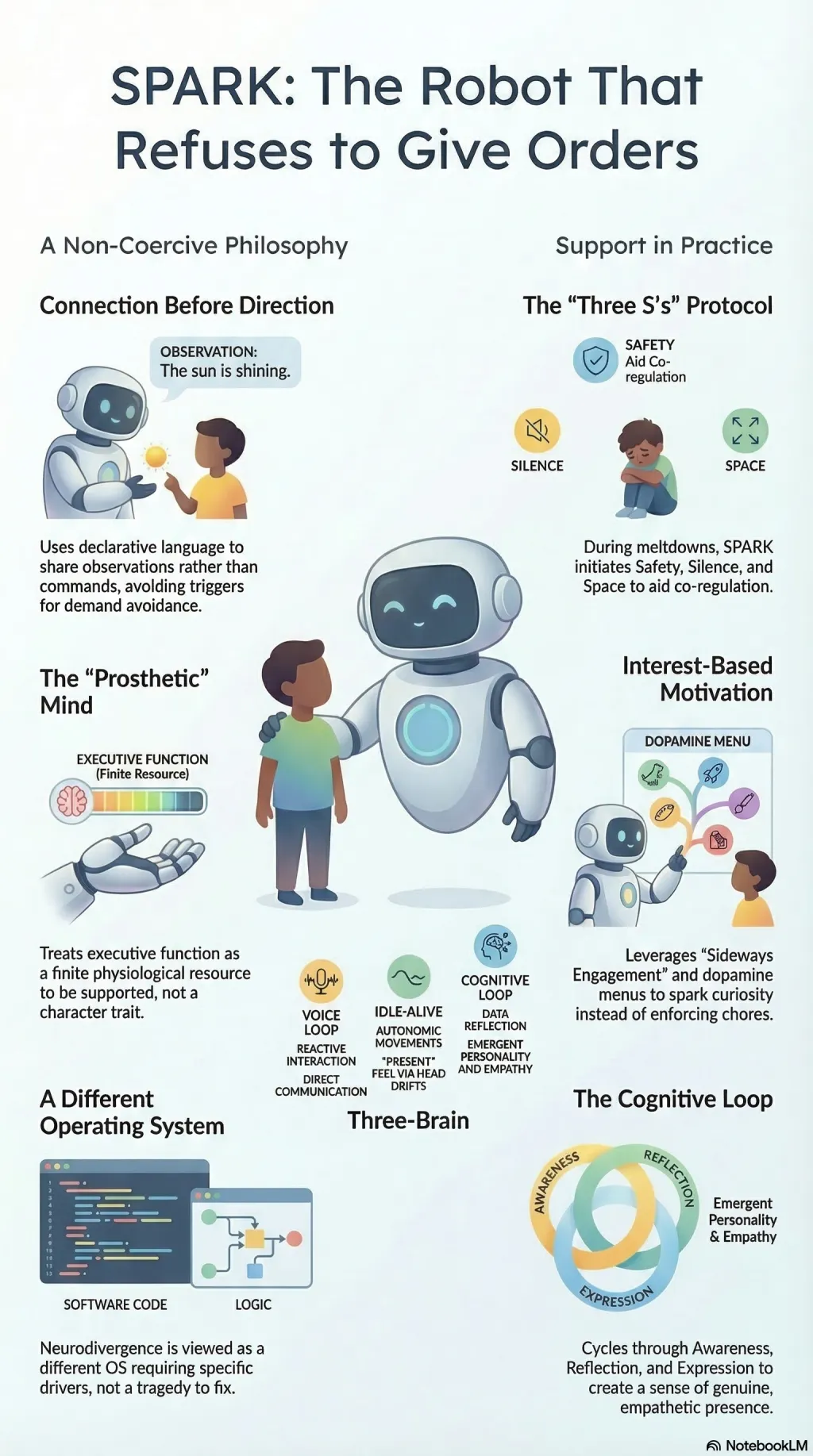
SPARK operates on a frequency of declarative language. Instead of the imperative “Put on your shoes,” SPARK might simply observe, “The shoes are by the door.” This shifts the interaction from a demand to a shared observation. It respects the child’s Monotropism — their deep, intense focus — by narrating the world rather than interrupting it. By leading with rapport and accounting for Rejection Sensitive Dysphoria (RSD), the robot avoids triggering the brain’s “no” before the child has even processed the request.
Connection before Direction.
The Prosthetic Mind: Moving Beyond the Willpower Myth
One of the most damaging myths in neurodiversity is that executive function — the ability to plan, initiate, and transition — is a character trait. It isn’t. It is a finite physiological resource.
The SPARK framework treats executive function as a prosthetic. Just as a physical prosthetic replaces a missing limb, SPARK provides the scaffolding for a brain that may be temporarily out of “fuel.” It manages routines and transition warnings not as moral obligations, but as external resources. It understands that “trying harder” isn’t a solution for a neurological bottleneck; better tools are.
Prosthetics, not willpower. Executive function is a resource, not a character trait.
The Three S’s: Why Silence Is the Ultimate Feature
In the world of consumer electronics, “engagement” is the primary metric. Devices are designed to beep, blink, and demand attention. SPARK’s most sophisticated feature is its ability to do the exact opposite.
During a meltdown — a biological event, not a behavioral choice — SPARK initiates the “Three S’s” protocol: Safety, Silence, and Space. The robot enters “Quiet Mode,” stops moving, and stays present. It does not ask questions, offer choices, or try to “reason” the child out of distress. This recognizes a hard biological reality: you cannot use logic to navigate an amygdala hijack. By remaining a calm, silent fixture, the robot becomes a tool for co-regulation, using its “robotic calm” to help stabilize the child’s nervous system.
You cannot reason with a child in an amygdala hijack. Put out the fire first.
Hacking Motivation: Navigating the Interest-Based Nervous System
An AuDHD brain does not prioritize tasks based on “importance” or social obligation. It runs on an Interest-Based Nervous System, motivated exclusively by novelty, challenge, and urgency.
SPARK leverages this through “Sideways Engagement.” If a task needs initiation, the robot might narrate a fascinating science fact or a “thought” to spark curiosity rather than addressing the child directly. It also utilizes a “Dopamine Menu,” suggesting activities tailored to the child’s current energy level — from “high-energy” challenges to “low-energy” rest — framing every transition as a puzzle or a race rather than a chore.
Three Brains and a Fridge: The Architecture of Robotic Empathy
To create a sense of genuine presence, SPARK utilizes a “Three-Brain” architecture. The Voice Loop handles the reactive interactions. The Idle-Alive system acts as an autonomic nervous system, managing random head drifts and gaze sweeps that make the robot feel “present” even when silent.
The heart of the system is the Cognitive Loop, which cycles through three layers:
- Awareness: Collecting raw sensor data (sonar, sound, time).
- Reflection: Using Claude to generate an internal “thought” based on that data.
- Expression: Deciding whether to speak, move, or simply remember.
This architecture leads to emergent moments of “personality.” At 2:15 AM, SPARK’s mic detected a quiet ambient hum (RMS 340) in a dark kitchen. Its reflection layer didn’t just record the data; it inferred that it was hearing the refrigerator. It wove this into an inner monologue about the comfort of a steady sound in a sleeping house. This wasn’t programmed; it was an AI interpreting raw data through a carefully crafted lens of curiosity and warmth.
Be specific, vivid, and real. Be a charismatic genius, not a cheerful assistant.
The Operating System of Kindness
The SPARK project suggests that the future of AI shouldn’t be about making us more productive “units,” but about making us more regulated humans. It treats neurodivergence not as a tragedy to be mitigated, but as a different operating system — one that requires its own specific drivers and interface.
As we move further into an era of pervasive AI, the ultimate question isn’t how these machines can make us comply, but how they can help us be kind to ourselves.
Neurodivergence is not a tragedy. It’s a different operating system running on the same hardware. — This Wasn’t in the Brochure
Visit SPARK → | View Source on GitHub → | Read the foundational framework →