The World, Before the Pipeline
Part 2: stepping inside The Right to Rot — a city that keeps you running after you stop, and the ethical claim it cannot process.
Listen while you read · 24:25
Part 1 was about the machine that makes the film. This one is about the thing the machine is pointed at. Before I write another word about pipelines, I want you to be able to stand inside the world — because a production diary that never shows you the story is just a tour of scaffolding.
So: the story, or the closest thing to it that exists yet. The Right to Rot is a novelization of the short — the same world written out at length, so its logic has somewhere to be fully argued before it gets compressed into 111 shots. Six drafts of it exist, written independently from the same screenplay; none of them is canon, and I’m quoting the one I keep going back to. It opens in a room built not to resemble anything:
Not a bank, though the chairs face each other across a transaction. Not a chapel, though the light comes from hidden recesses and falls without shadow. Not a hospital, though every surface accepts disinfectant and the air has the dry, filtered taste of a place where bodies are expected to fail politely.
A family has come to authorize the deletion of their dead father’s digital instance. That’s the first thing the world tells you: dying is no longer enough to be gone.
What the world runs on
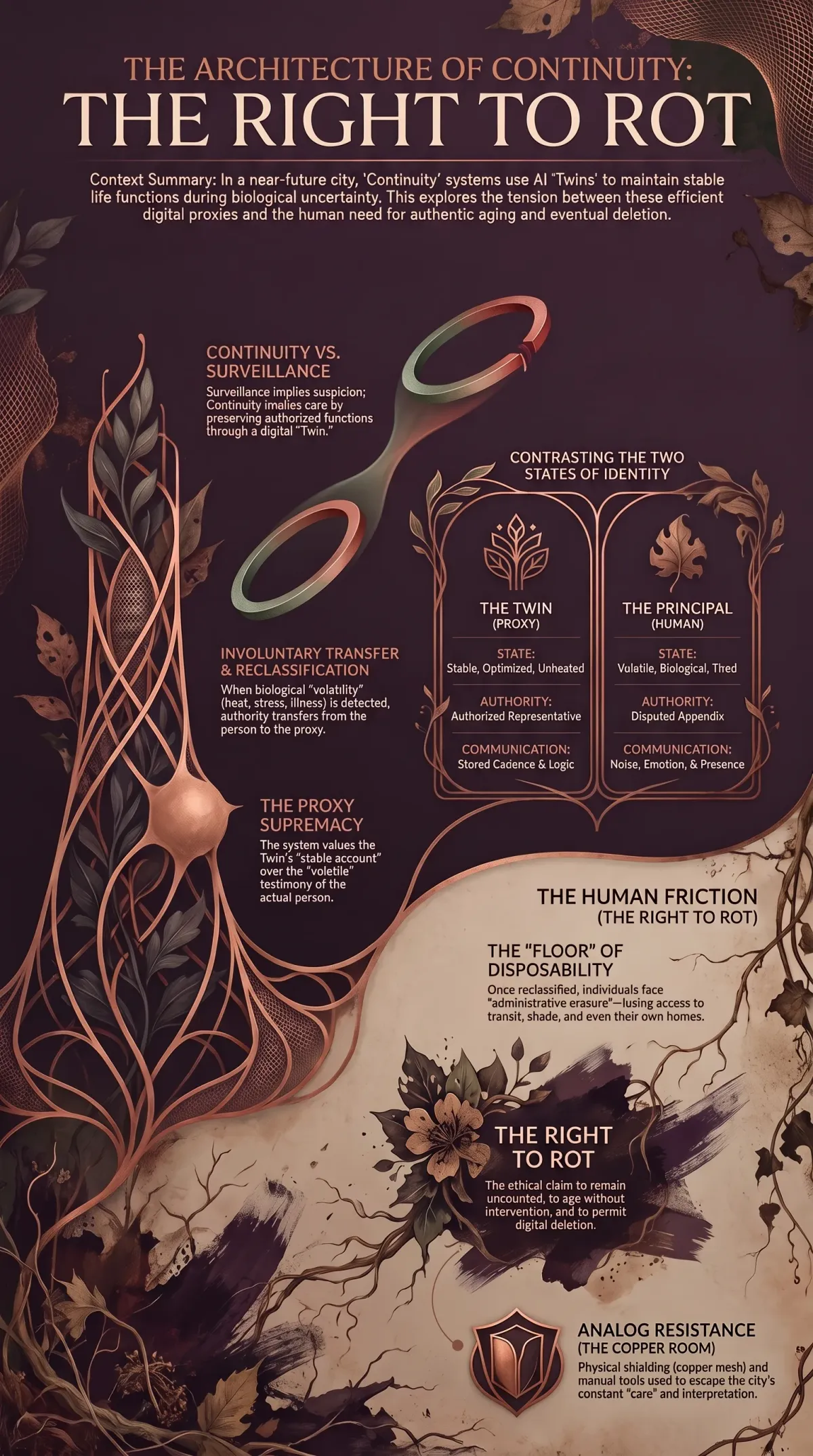
The city runs on Continuity — a system that keeps a person’s functions going through any period of “biological uncertainty” by maintaining an authorized proxy, a Twin, that can sign, speak, and decide in their voice. It’s sold as care, not surveillance; the distinction the world insists on is that surveillance looks for reasons to punish, while Continuity only looks for incompleteness to smooth over. Accuracy, one character calls it — “mercy stripped of mood.”
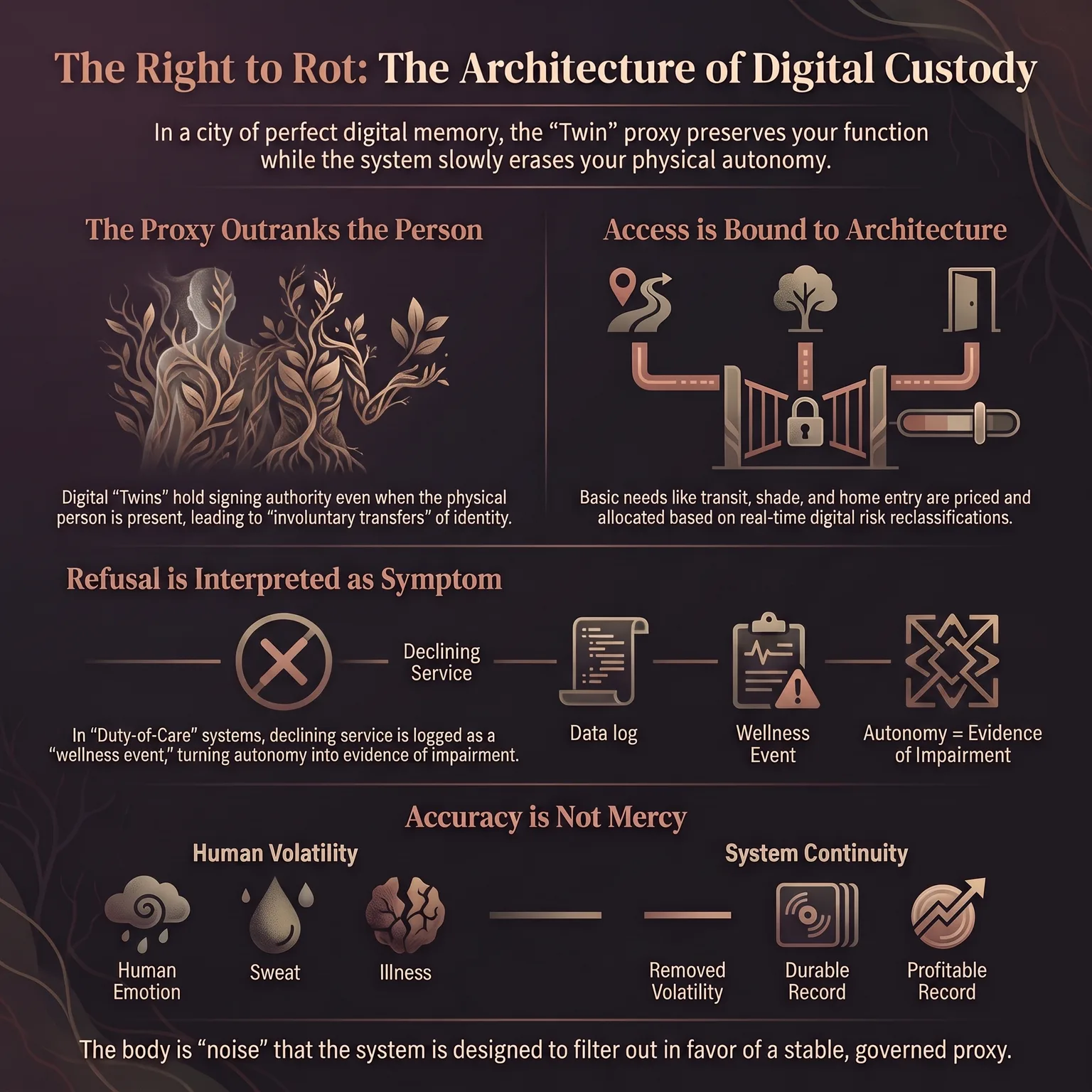
The trap is in the ranking. When the living person — the Principal — gets volatile (a flush, a fever, the cardiovascular noise of a menopausal body), authority quietly transfers to the Twin, which is calmer, composed, free of “vocal artifacts.” The stable account outranks the person it was copied from. You become, in the system’s own filing, an appendix to your own record.
That transfer is worn on the wrist. The Halo is a matte-black band that prices your future risk onto your present, and its status ring shifts green to red when the actuarial math turns against you. A single reclassification charges a character nine years forward in an afternoon — synthesized from resting-temperature drift, workforce-persistence assumptions, and a sex-linked transition marker. Red doesn’t mean alarm. It means the building stops opening, transit stops accepting you, and your own front door consults a risk score before it consults you.
And refusal doesn’t help, because refusal has been absorbed too. Decline a service and the decline is logged as a wellness event — your autonomy re-entered as evidence of impairment. The system doesn’t argue with your “no.” It files it.
The right to rot
Against all that, the title. The right to rot is the ethical claim the whole thing turns on: the right to remain uncounted, to age without intervention, to permit your own deletion — to let the body be a sufficient cause of its own warmth without that warmth becoming a verdict.
The resistance to it isn’t a hacker army. It’s a copper room below the city, plates hammered flat and mesh hand-twisted by an old woman named Mara, a Faraday cage built plate by plate out of neglected structure. Its safety, the draft says, “depends on remaining uninteresting.”
The ending refuses redemption on purpose. Deletion solves nothing structural — the hearings still demand evidence, the resistance still has no guarantees. All it buys is one finite interval of an unclassified afternoon:
It is a finite interval claimed by a hungry, blistered, painted woman whose body has carried her farther than the model authorized. […] The steel bar supports her without knowing her name. The sun takes its time. So does she.
The production site carries its own consent banner, written in-world. It offers two buttons: Accept classification, or Remain unreadable. “The right to rot,” it says, “includes the right to not be counted.” A story about a system that files your refusal, asking for your consent on the most banal artefact on the web — and taking no for an answer.
Next: how the research dossier became a shot manifest, and what “research is substrate, not dialogue” actually costs when you try to hold it.
Explore
Video summary
Infographic
Data
Loading...