The Research Underneath the Film
Part 3: the twelve-essay corpus that sits under The Ungovernable Body, why a short film needed one, and where to start reading it.
Listen while you read · 21:11
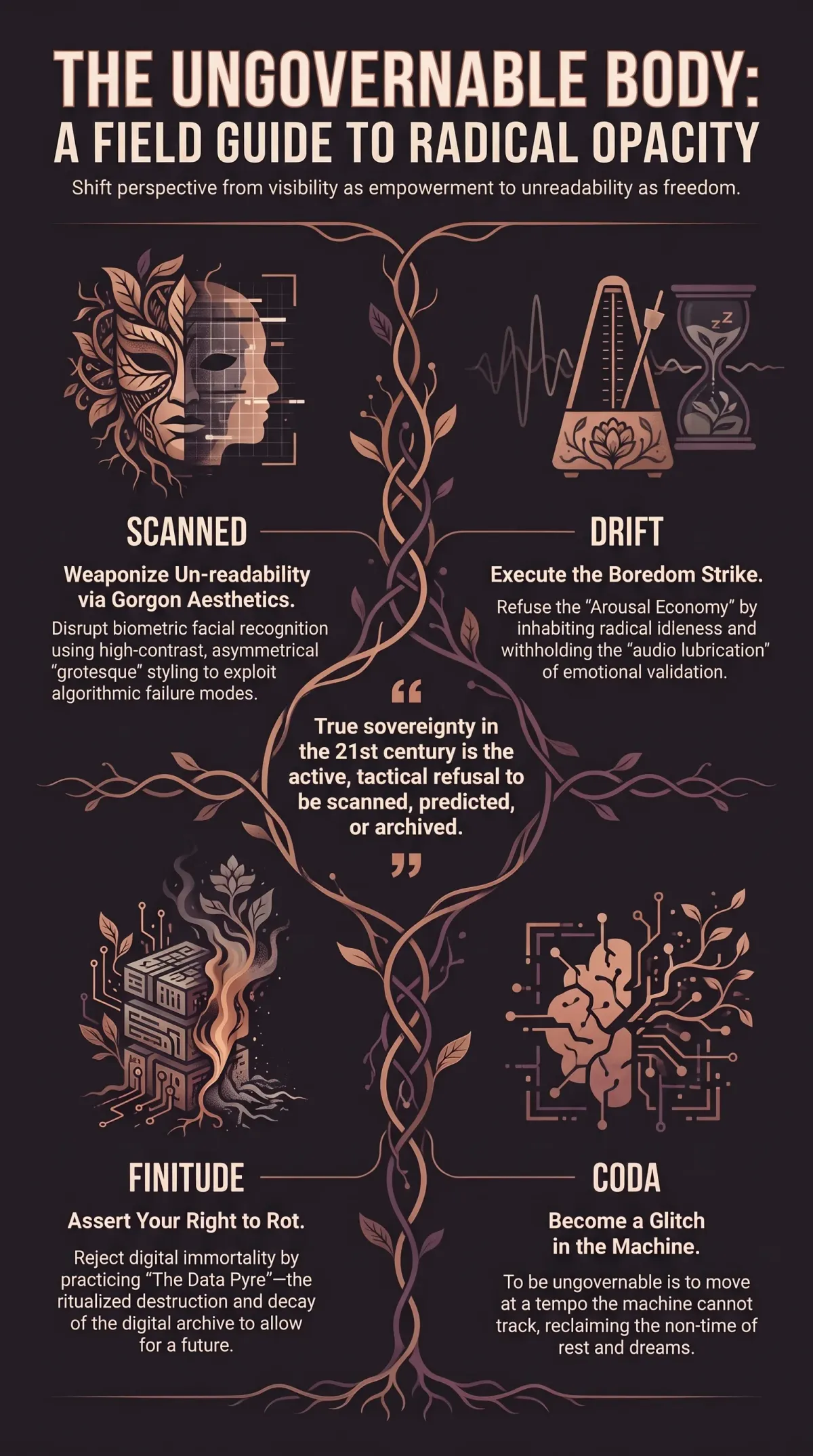
Part 1 was the machine that makes the film. Part 2 was the world the machine is pointed at. This one is about the thing underneath both, which I have been referring to obliquely for two posts without ever showing you: there is a research corpus, it is twelve essays long, and it is the reason the film has a position rather than a mood.
I want to explain why it exists, because “I wrote a book of theory before making a twenty-minute short” is a defensible sentence only if the second half depended on the first.
Why a short film needed a corpus
The failure mode I described in Part 1 was the film-shaped object — footage that looks like cinema but doesn’t cause anything. There is a second version of that failure that worries me more, and it doesn’t show up in the rushes. It’s the politics-shaped object: a story that gestures at surveillance and bodily autonomy, borrows the visual language of dissent, and on inspection is not actually arguing anything. Near-future dystopia is a genre with a very well-stocked prop cupboard. You can build something that reads as critique entirely out of set dressing.
The way I know to avoid that is to make the argument first, in prose, where it can be wrong in public. If the claim doesn’t survive being written down plainly, it will not survive being dramatised. The film can then compress, dramatise and complicate a position that already exists, instead of implying one it hasn’t got.
So Elara Vance’s menopause being classified as catastrophic asset depreciation is not a premise I reached for because it sounded striking. It’s the dramatisation of a specific argument about algorithmic underwriting that took an essay to make properly.
What the corpus argues
The through-line is legibility. The claim is that the demand to be readable — by a state, an insurer, a platform, a city — is the demand to be governable, and that the freedom worth defending is the freedom to remain, in some part, unreadable.
It runs in four movements. Volume 1 is about being scanned: how bodies are made legible, priced, and sorted, and what it costs the people who read badly. Volume 2 is about refusal: whether withdrawal, silence and rest can function as tactics rather than symptoms. Volume 3 is about finitude: the right to be forgotten, to delete, to have a past that fades. Volume 4 closes it out on time and the persistence of the present.
The twelve
Each of these is a blog-length adaptation of a longer chapter. They stand alone and can be read in any order, though they were written to run in sequence.
Volume 0 — Introduction
- The Glass Cage — legibility, and why visibility is not the same thing as power
Volume 1 — Scanned: the politics of legibility
- The Bio-Age Trap — biological age as an underwriting instrument
- The Gorgon Protocol — adversarial aesthetics and the uses of being unrecognisable
- The Ghost in the City — hostile architecture and the people a street quietly excludes
Volume 2 — Drift: the architecture of refusal
- The Boredom Strike — the attention economy wants arousal, and boredom is the state it can’t sell
- Weaponized Silence — silence as withdrawn labour rather than absence
- Sleep Sovereignty — the annexation of the one interval that produces nothing
Volume 3 — Finitude and deletion
- The Analog Insurrection — disconnection as a luxury good, and the class line it draws
- The Right to Be Forgotten — finitude as a right, and the digital afterlife industry
- Memory Wars and Data Leakage — the recorded self against the remembered one
- The Data Pyre — deletion needs a ceremony, and we lost ours
Volume 4 — Coda
- The Hauntology of the Infinite Now — a present permanently stalked by everything it kept
A note on what these are
These posts are adaptations. The chapters are the canonical text, they are considerably longer, and they carry the citations. Where a post and a chapter disagree, the chapter is right — I compressed roughly five thousand words into fourteen hundred twelve times over, and compression loses things.
I’d rather say that plainly than let the short version quietly become the record. The full corpus lives at ungovernable-body.wedd.au, alongside the screenplay, the production system and everything else this project has accumulated.
Part 4 goes back to the pipeline.