Factory Floor
A reproducible 3D-printing pipeline: every part starts as a project.yaml, gets validated and dry-run sliced, and nothing prints without a human sign-off.
Listen while you read · 21:34
Related episodes
Most of my 3D-printing workflow used to live in my head: rough dimensions in a note, a slicer profile I vaguely remembered tuning, a print that came out fine but that I couldn’t recreate if I had to. Factory Floor is the attempt to fix that — a private workshop for making printed things properly: measured, validated, sliced, reviewed, then printed, in that order, never skipped.
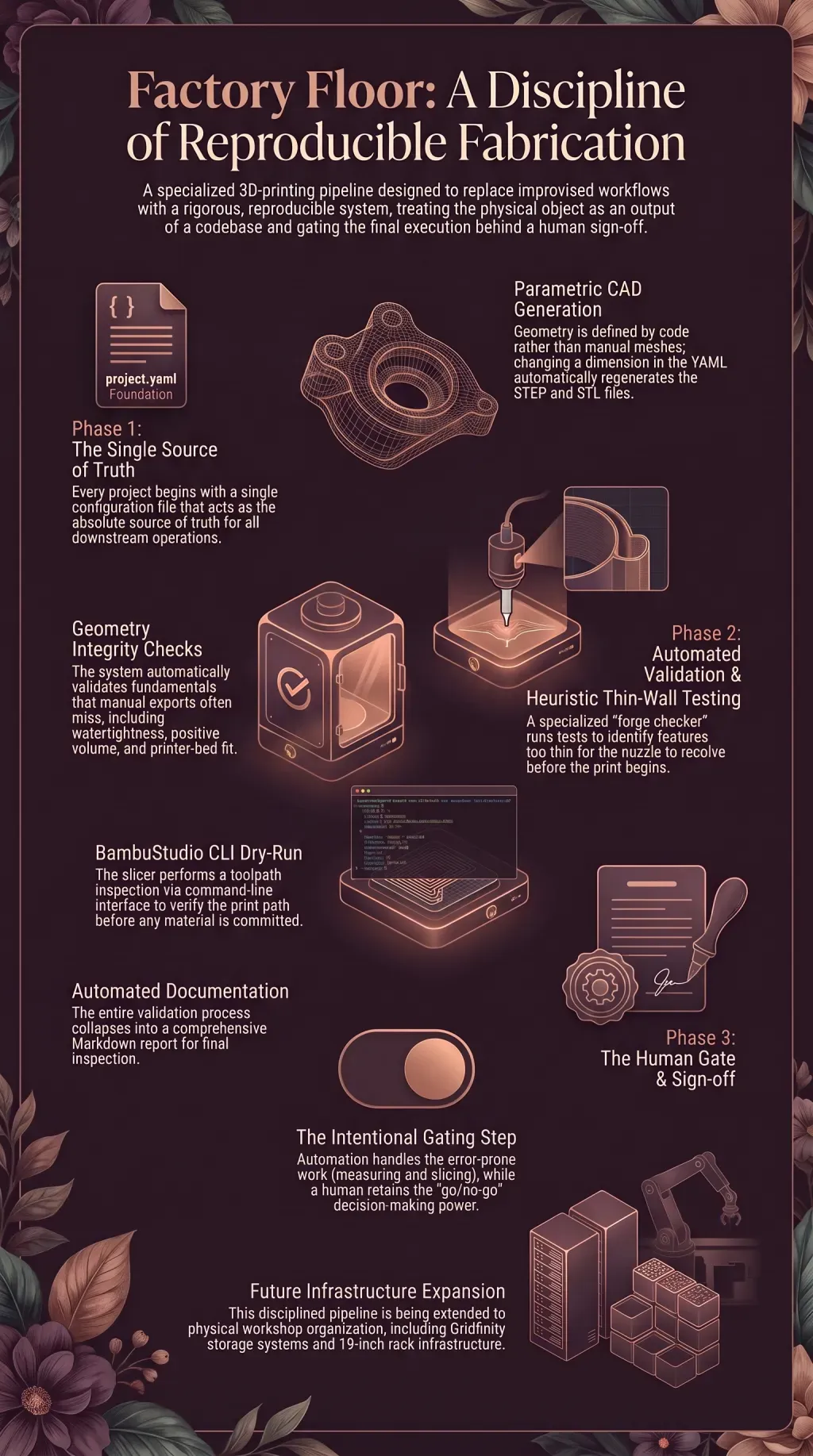
The point is reproducibility. Every project starts as a project.yaml — the single source of truth — and everything downstream is generated from it. Nothing reaches the printer without a human looking at the report first.
The pipeline
idea / photo / measurements
  → project.yaml (source of truth)
  → parametric CAD (build123d)
  → STEP + STL export
  → geometry validation
  → slicer dry run (BambuStudio CLI)
  → Markdown report
  → human approval
  → print
  → notes → revised version
Parametric CAD means the geometry is code, not a mouse-dragged mesh — change a dimension in the YAML and the STEP and STL regenerate. Geometry validation checks the fundamentals that a bad export gets wrong — watertightness, positive volume, dimensions, and printer-bed fit — and a separate forge checker runs a heuristic thin-wall test to flag features the nozzle can’t resolve. The BambuStudio CLI then does a dry-run slice so the toolpath is inspected before filament is committed, and the whole thing collapses into a Markdown report a human reads and signs off on.
Why gate on a human
The temptation with a pipeline like this is to close the loop and let it print unattended. Factory Floor deliberately doesn’t. The approval step is the point: automation does the tedious, error-prone, easy-to-forget work — measuring, validating, slicing, documenting — and a person makes the go/no-go call with a full report in front of them. It’s the same instinct as gating a deploy: the machine prepares the change and proves it’s sound; a human owns the decision to ship it.
The workshop itself is now under the same discipline — a Gridfinity cable-storage bin and 19-inch rack cable management have each traversed the full pipeline to ready_for_human_print_review, modelled and validated from a source of truth rather than improvised, waiting on the human go.