Understory
A proposal-rigor lab stress-testing stacked low-capital income streams on a Tasmanian conservation parcel. Claims tagged, challenged, and gated.
Listen while you read · 19:29
Related episodes
Understory is a rigor lab, not a venture. It stress-tests whether a set of stacked, low-startup-capital income streams could work on a 69-hectare Landscape Conservation Zone parcel at Cygnet, in southern Tasmania. There is no business here and nothing is being offered — it’s a workspace for thinking about an idea properly before anyone is asked to believe in it.
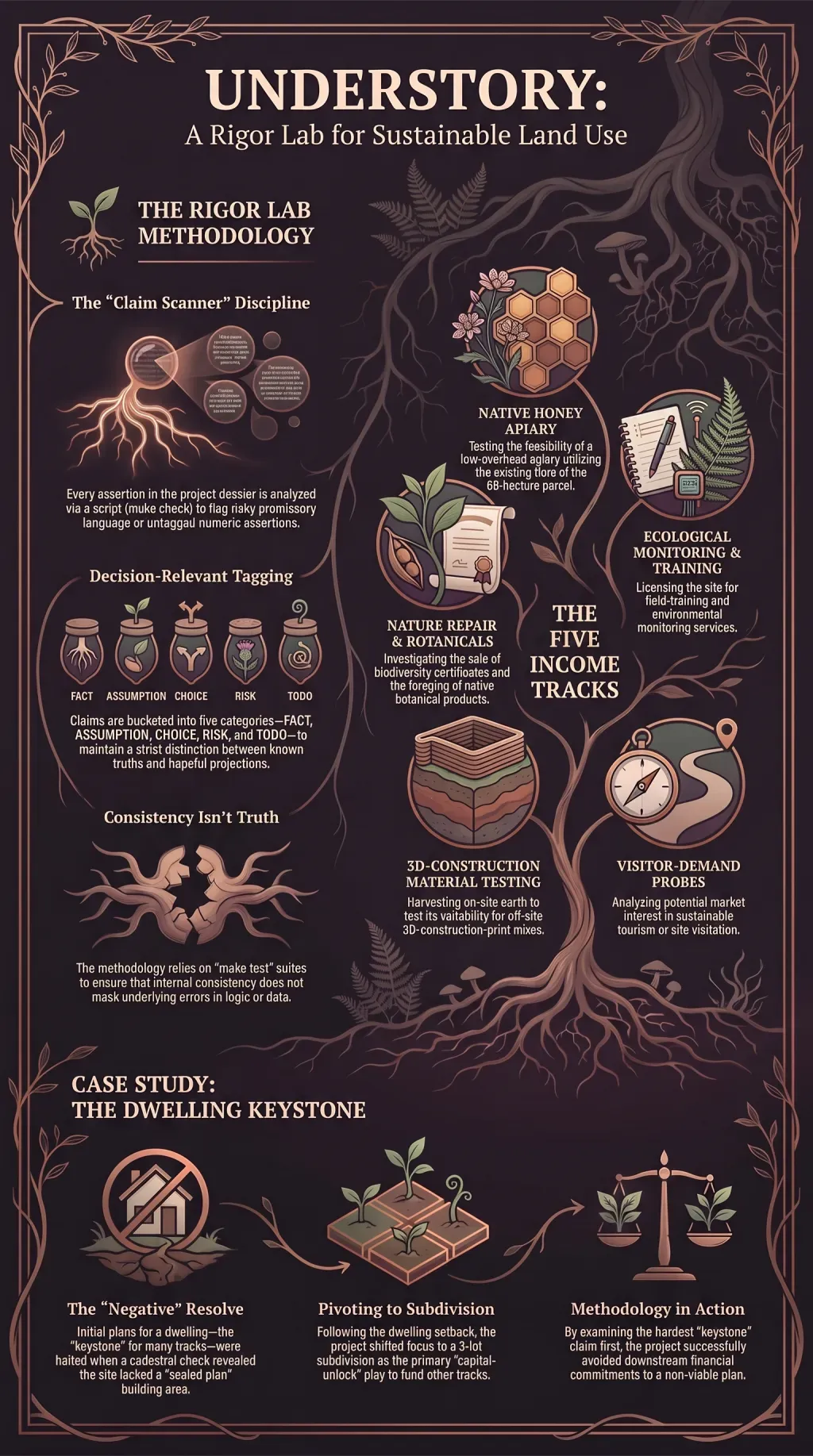
The discipline is the deliverable. Decision-relevant claims are bucketed — FACT / ASSUMPTION / CHOICE / RISK / TODO — then stress-tested and gated before they’re allowed to inform a decision. A claim scanner runs over the docs (make check), flagging risky promissory language and numeric assertions that carry no bucket tag, and a test suite backs the analysis (make test) — so the distinction between what is known and what is merely hoped doesn’t quietly erode as the document grows. Consistency isn’t truth, and the tagging is what keeps the two apart.
The tracks
The original portfolio tracks six income streams that could share the same land and overheads rather than each carrying their own, plus a subdivision investigation that funds the rest (the public dossier set has since grown past these — filming and location hire and a carbon ACCU desk-check among the additions):
- a native honey apiary;
- ecological monitoring and field-training site licensing;
- native botanicals foraging;
- Nature Repair biodiversity certificates;
- visitor-demand probes;
- on-site earth harvested for off-site 3D-construction-print mix testing;
- and — separately from the income tracks — a 3-lot subdivision investigation as a capital-unlock play.
Cutting across the income tracks — tagged in the dossier itself as an ASSUMPTION, not a fact — is Dossier 00, the dwelling keystone: originally a sealed-plan building-area check, on the theory that a dwelling underwrote the residential-business, hosting, and hazard-buffer uses the other tracks lean on. That check resolved negative — the title is a cadastral diagram, not a sealed plan, and shows no building area, so a new dwelling defaults to the Discretionary planning pathway. The next move is deliberately not council contact: a planning consultant (and possibly legal advice) comes first, because the sequencing risk is itself documented. Meanwhile the subdivision has become the true capital-unlock keystone. It’s a working example of the method paying off: the keystone was examined first and hardest, and the answer changed the shape of everything downstream.
Sibling methodology
Understory shares its method with printworks-coop, a parallel lab asking whether a community-owned 3D-house-printing co-operative in southern Tasmania is worth pursuing. Same tagging discipline, same claim scanner, same refusal to let an attractive narrative outrun the evidence. Both exist to answer one question honestly — is this worth doing? — before any capital, land, or reputation is committed to the answer.