Memory Wars and Data Leakage
The state wants a self that remembers everything and contradicts nothing. A body that forgets is not a broken citizen but one the file can no longer hold.
Listen while you read · 19:30
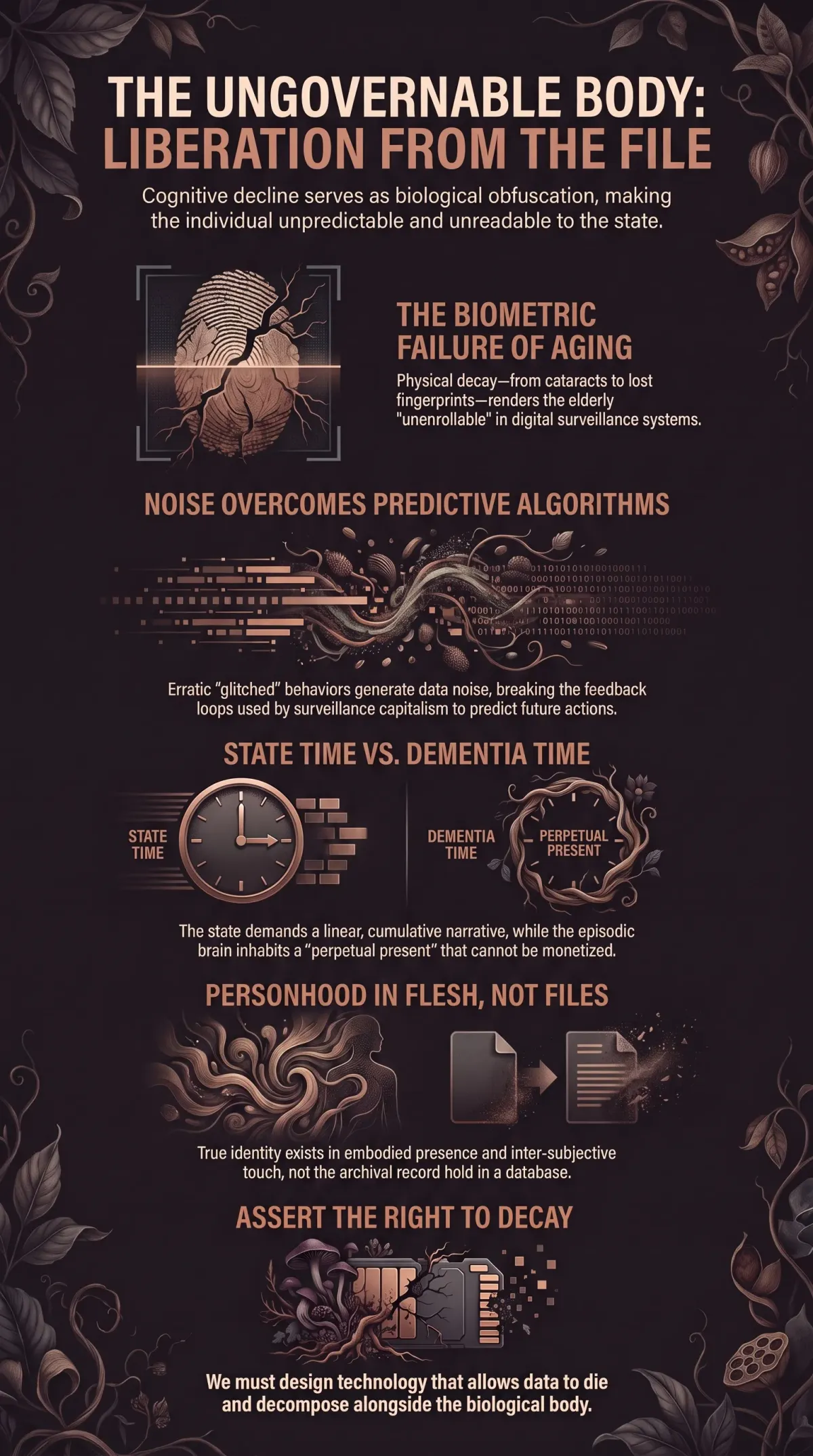
An iris scanner fails on an eighty-year-old with a cataract. A fingerprint reader can’t find the ridges on a hand that has lost collagen. A face-matching model looks at a woman in her seventies and does not see the woman in her fifties whose photo is on file.
Every one of those is logged as an error. None of them is. They are the machine being told the truth: that the body it was built to read is not a fixed object, and never was.
I want to take that failure seriously, because I think it’s the most interesting political fact of the decade, and almost everyone involved is treating it as a support ticket.
The file is the citizen
Modern governance doesn’t really interact with your body. It interacts with your file.
Your credit history, health record, travel logs and biometric templates are collected separately, from different places, then reassembled into something that stands in for you. That composite is what crosses the border, gets the loan or doesn’t, and gets flagged as worth a second look. Your actual flesh follows behind it, mostly as a way of confirming the file was right.
If you’re healthy and solvent and your life is going roughly to plan you don’t feel this, because your relationship with the file is cooperative. You keep the credit clean. You renew the passport before the photo drifts. You perform coherence all day without ever calling it that, and in exchange you move through the checkpoints without friction.
The arrangement only shows itself when the two come apart. When person and record diverge, the system does not conclude the record is out of date. It concludes something has gone wrong with the person. Divergence gets filed as noise, or fraud, or risk.
That’s the mechanism. Everything else follows from it.
Why the state trusts your body more than your word
There’s a reason identification keeps moving from documents towards biometrics, and it isn’t only convenience.
Bureaucracies have decided that what you say about yourself is unreliable. Names change. Stories shift. Paperwork can be forged. So identity gets anchored in the thing assumed to be immutable: the iris, the print, the DNA. The body becomes the password — not a vessel for a person but a key that unlocks the rights of a citizen, checkable without the citizen’s cooperation.
The anxiety underneath that move is real and the solution rests on a mistake. The flesh is not immutable. It’s a decaying, morphing substrate that reliably stops matching its own earlier readings. Ageing is entropy applied to exactly the features these systems need to hold still. The biometric state has a design flaw at its foundation and the flaw is called getting old.
Two ways of being a self
Underneath the technical demand there’s a philosophical one, and it’s doing more work than the technology.
The state assumes what Galen Strawson calls a diachronic self. That’s the person who experiences themselves as one continuous thing stretching from the past into the future, an unbroken chain of custody, accountable now for what they did then. Life as a story with a beginning, a middle and an end.
Strawson’s point is that this is one way of experiencing a self, not the only one. Plenty of people are episodic. They know perfectly well they’re the same human being as the child in the photograph. They just don’t feel they’re the same self. The past is another country, inhabited by somebody else who happened to share their body. Strawson goes further than I need him to — he thinks the demand for narrativity pushes people to falsify their own experience to fit a storyline. I’ll settle for the weaker claim: neither mode is more true, and only one is legible to institutions.
The whole apparatus of accountability is built for diachronic people, and the demand is enforced hardest where the stakes are highest. In asylum determination, a claimant’s credibility often turns on the consistency of their account; gaps, non-linearity and contradiction get read as fabrication rather than as what they usually are — trauma, translation, or the ordinary unreliability of memory. The operating definition of truth becomes structural. Truth is whatever is consistent. Incoherence is a lie.
Set that standard against a brain and the brain loses. Databases are searchable and consistent. Human memory is reconstructive, episodic, and full of holes it papers over without telling you.
Losing the archive is not losing the person
Here’s where the harm gets concrete.
Western law and medicine inherited an idea from Locke that ties the person to the continuity of their memory. If you can’t remember doing it, you aren’t quite the one who did it. That was liberating when it was invented. In a world of permanent records it has become a machine for producing non-persons.
If personhood depends on remembering, then the database, which remembers everything, has a better claim to being you than you do. The person with advanced dementia gets described as an empty shell, a living ghost, gone. The body is still there. What’s missing are the keys to the archive, and we’ve agreed the archive is where the person was kept.
I don’t accept the premise, and Paul Ricoeur is the reason. Ricoeur separates idem — the sameness of an entity, objective continuity, the thing a fingerprint verifies — from ipse, the selfhood of someone who is present, who responds, who acts. The second doesn’t require the first. The cognitivist model that underpins Western law and medicine collapses the two, and that collapse is what turns a patient into an empty shell.
Pia Kontos calls what survives embodied selfhood: enacted body memories, emotional attunements, the sense-making a person does with their hands and their attention in a room. On her account the body remembers how to be a person long after the mind has lost the story of that person.
And crucially, that kind of self can’t be uploaded. You can upload the record of a moment of shared laughter. You cannot upload the laughter. Whatever it is that stays is the part that stays offline.
It’s worth noting that Ricoeur doesn’t treat forgetting as the enemy in any of this. For him it’s the condition that makes memory possible — the shedding is what gives a life a shape rather than an infinite list. The database inverts that. It is built to shed nothing, and then it is used to judge a brain that must.
The noise hypothesis
There’s an argument I keep meeting in this literature. It’s half right, and the other half is dangerous, so it’s worth stating fairly before taking it apart.
Surveillance economics needs you to be a rational actor with a stable trajectory — the value in your data is that your past forecasts your future, and futures can be sold. Finn Brunton and Helen Nissenbaum describe obfuscation, the deliberate flooding of trackers with plausible junk, as a weapon of the weak: a tactic for people who have already lost the fight over collection. The suggestion is that the ageing, forgetting, wandering body does the same thing involuntarily. Call it biological obfuscation. Behaviour that is reactive rather than intentional still generates data; it may not generate signal.
The underlying research is careful to frame this as a hypothesis about how the surveillance apparatus fails, and it should stay framed that way, because as a description of what happens to actual people it doesn’t hold up.
Start with the reconciliation problem. I have argued elsewhere that a slow gait, a meandering path and a person who stops twice on the same block are precisely the inputs an anomaly detector is built to flag — that these systems read unpredictability as threat, not as opacity. Both cannot be true at once. Being unreadable to a face-matcher is not the same as being invisible to a behaviour classifier, and the second is tuned to notice exactly the person the first cannot resolve. Failing to match your enrolment photo doesn’t remove you from the dragnet; it moves you into the queue for secondary inspection. Illegibility buys opacity in one layer and scrutiny in the next.
Then there’s the cost, which the framing skips. A person whose behaviour has stopped being predictable is not a privacy activist. They may be unable to consent, unable to manage money, unable to leave the house safely, dependent on others for nearly everything. Vulnerability to fraud goes up. Exposure to abuse goes up — and safeguarding, the apparatus meant to address that, is itself a surveillance regime, generally the most intimate one a person will ever live under. Whatever is being withdrawn from the behavioural futures market is being paid for by someone at a price they never agreed to.
So I’ll keep the structural observation and drop the celebration. That the predictive machine cannot model an unravelling person says something real about the machine’s assumptions. It says nothing good about the person’s week. Cognitive decline is not liberation, and I’m suspicious of any argument that needs it to be.
The unreliable narrator
What survives is smaller and harder to argue with.
Everyone curates. We prune the search history, choose the photo, keep the credit clean. The coherent citizen the system recognises is substantially a performance, and the performance is the price of frictionless passage. We lie to the model to fit the model.
Someone who has lost the capacity for that curation has lost, specifically, the capacity to deceive in the sophisticated way the rest of us do. They cannot tell the story the state wants to hear — and they are not telling a better one either, not testimony or protest or anything amounting to a position. They have simply stopped performing, and that makes visible how much performing the rest of us do without noticing.
Which is the finding. The demand for a perfectly consistent self is not a neutral administrative convenience. It’s a demand that everyone impersonate a database, enforced hardest on those least able to comply — the asylum seeker whose account has gaps, the patient whose account has holes. The file was always an interface and never the person. Whether it should also be allowed to end is the next question.
The world we’re building is one where you’re required to be a perfect machine, and where the moment your body starts telling the truth about being a body, the system files that truth as an error.
I’d rather be an error.