Sleep Sovereignty
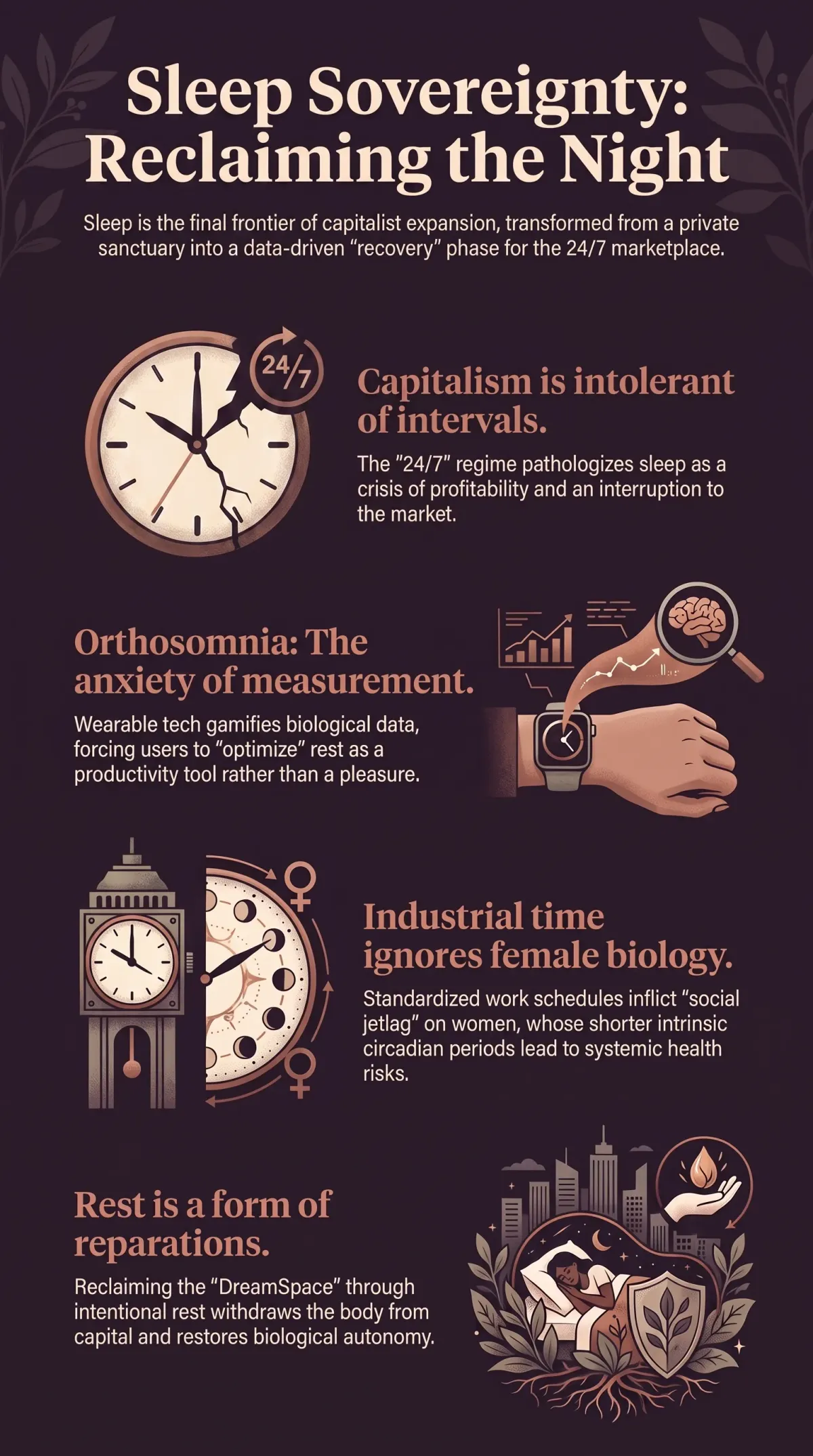
Sleep is the last stretch of a life the market cannot easily harvest. The 24/7 economy, the wearable and the industrial clock have all gone after it anyway.
Listen while you read · 23:46
For a great many people the first act of the day is now checking how they slept. Not by noticing how they feel — by picking up a device and reading a number. Some mornings the number is low and the day acquires a weight it didn’t have thirty seconds earlier. Some mornings it’s high and the tiredness gets overruled.
That’s a small thing. It’s also the whole argument in miniature. Something people used to know from the inside, they now learn from the outside, from a system that has its own reasons for telling them.
Sleep is the last stretch of a human life that produces nothing. For a third of every day the body withdraws from the market entirely: buys nothing, makes nothing, watches nothing, can’t be reached. Every other interval has been closed. Waiting rooms, commutes, queues, the toilet, the ninety seconds between one video and the next — all of it has been filled with something that generates value for someone. Sleep held out longer than any of them, not because anyone defended it but because it’s non-negotiable at the level of the organism.
So it got approached differently. You can’t abolish sleep, so you annex it.
The body as a machine that needs downtime
The annexation runs on an old idea. Industrial management, a century ago, settled on the body as a mechanism — a thing whose motions could be timed, standardised and stripped of waste. That framing was about the factory floor, but it doesn’t stop at the factory door. If the body is a machine, then sleep isn’t a state of being. It’s preventative maintenance. Downtime scheduled to prevent failure. Valuable strictly in proportion to what it makes possible the next morning.
You can hear that logic intact in the language sold to us now. A tracker doesn’t tell you that you rested. It gives you a recovery score, a readiness score. Recovered for what? Ready for what? The words only mean anything if the night is a preparation for something else. Nobody markets a device that scores how good the night felt. There’s no revenue in that.
Before industrial lighting and the factory shift, a lot of people slept in two blocks with a waking interval between them, often given over to reflection, prayer, sex, or nothing at all. The single consolidated eight-hour block isn’t nature. It’s a schedule, and it was designed around the hours it needed to leave free.
The device that tells you how you feel
I don’t think the sleep trackers are a conspiracy. I think they’re worse than that: they’re sincere, and they still do the damage.
The mechanism is simple. The night becomes a performance. A performance produces a score. A score can be good or bad. And now the anxiety of the score is in the bed with you — which is a genuinely stupid outcome, since anxiety is the thing most reliably capable of wrecking sleep. Clinicians have a name for it now: orthosomnia, the pursuit of perfect sleep data at the direct expense of sleeping. The tool built to solve the problem is a live cause of it.
Underneath that there’s a quieter loss. Interoception is your capacity to read your own internal state — hunger, fatigue, the difference between tired and unwell. It’s a skill, and it degrades when you stop using it. Every morning you check the app before you check yourself, you outsource a small piece of self-knowledge to a company. Given enough mornings you reach the point where the data disagrees with your body and you believe the data. That’s not a monitoring relationship. That’s an authority relationship.
And it points somewhere. The bedroom is now instrumented — heart rate variability, respiration, skin temperature, movement, every night, at a granularity no doctor ever had. That data doesn’t stay still. Insurers have already used compliance data from medical devices to decide what they’ll cover. The distance between “prove you used your CPAP” and “prove you slept well enough to be insurable” is not a distance of principle. It’s a distance of appetite.
The real trick of the individualised model is where it puts the blame. If you’re exhausted, the tracker’s implicit story is that you failed — poor discipline, bad hygiene, wrong glasses, screens too late. Not that you work sixty hours. Not that your roster is designed around coverage rather than around people. A structural problem gets handed back to you as a personal shortcoming, along with a subscription that helps you manage it.
The clock was never neutral
The standard workday presents itself as a container: a neutral 24-hour grid that everyone fits into equally. It isn’t, and the evidence isn’t subtle.
Intrinsic circadian periods differ by sex — women’s average around 24.09 hours, men’s around 24.19, with a greater proportion of women running shorter than the solar day. That sounds trivial. It isn’t, because the mismatch compounds every single day and the schedule never bends. Social jetlag is the name for the gap between the clock your biology keeps and the clock your roster imposes, and the body pays the difference in chronic instalments.
For women that bill is measurably heavier. Shift work is associated with disrupted menstrual cycles, more severe symptoms, higher rates of endometriosis, elevated risk of preterm and low birth weight babies. These get filed as occupational hazards, as though they were an unavoidable cost of the work rather than a cost of the timetable — a timetable that could be different, and was chosen. A cyclic physiology has been fitted into linear industrial time and told the resulting damage is its own problem.
Which is why corporate sleep hygiene programmes are close to insulting. Darken the room, skip the coffee, wind down earlier. None of that touches a clopening — closing at midnight and opening at six. No amount of hygiene resolves a conflict that lives in the roster. The advice exists to relocate responsibility from the schedule onto the person the schedule is grinding down.
What sleep is for
Here’s what I think the counter-position actually is, and it isn’t better sleep.
The dream is the last mode of thought that can’t be made useful. It’s images produced at no one’s request, unsellable, unrankable, resistant to explanation. The Surrealists took this seriously as a political fact — not therapy, not symptom, but proof that the mind holds a register the daylight economy can’t reach or discipline. Breton’s claim was that the dream and waking life feed each other, and that what you can imagine at night sets the limit of what you can demand during the day. Lose that capacity and you lose the ability to picture arrangements other than the current one. That’s the deepest enclosure: not stolen hours, but a stolen imagination.
The contemporary version is blunter and I like it more. Tricia Hersey’s line is that rest is resistance and rest is reparations — that the body is not human capital, and lying down is a refusal to donate it. Note what that isn’t. It isn’t the power nap. The power nap is the enemy position wearing a friendly face: rest justified by the output it improves. Hersey’s version needs no justification at all, and that’s the entire point.
Sleeping bodies have done political work directly, too. Occupy was, in practical terms, an act of public sleeping in a financial district — the private act made into an obstruction. China’s tang ping, lying flat, is a generation declining to sprint and refusing to be shamed about it. In each case the body stops, and the stopping is the message.
So the position I’d defend is narrow and stubborn. Sleep sovereignty is not eight hours, a cool room and a high score. It’s the claim that a third of your life is not addressable — not by your employer, not by your insurer, not by a ring on your finger with a subscription attached. You do not sleep in order to work. You sleep because it is yours.
I still wear the thing. I like the data — I like it more than I’m comfortable admitting. That’s the part worth sitting with: the argument above isn’t a description of someone who has opted out. It’s what it looks like to hand over a third of your life to a company that profits from it, understand exactly how that could come back to haunt you, and keep the watch on anyway.