The Hauntology of the Infinite Now
Digital media carries no visible wear, so the past never reads as over. On hauntology, retromania, and a culture that struggles to finish anything.
Listen while you read · 24:22
Pick up a colour photograph from the seventies and you read a date before you read a face. The dye has shifted. The paper has gone warm at the edges. Nothing is printed on it that tells you when it was taken; the object has simply aged, in the same direction you have, and that ageing is legible at a glance.
A JPEG of last Tuesday and a JPEG scanned from 1974 arrive on a screen in the same condition. Same crispness, same load time, same apparent distance from now. Whatever else the digital archive did, it weakened the sensory cue that told us how far away something was.
That sounds like a small aesthetic loss. I think it’s the mechanism behind something much larger, and the last thing I want to say in this series: a culture that struggles to make a future, because it has lost the habit of finishing a past.
Decay was doing work
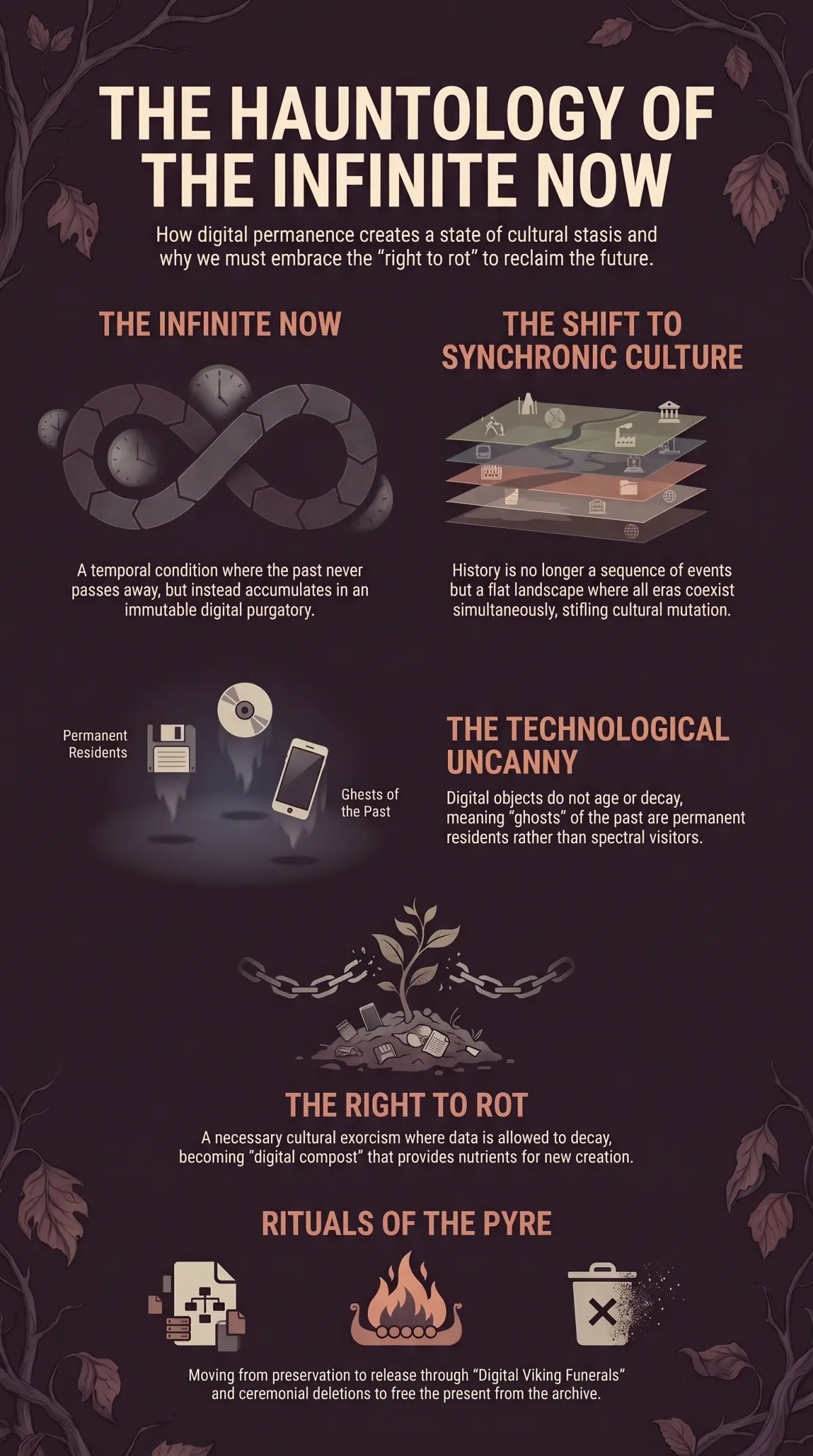
The vocabulary comes from Jacques Derrida, who coined hauntology in Specters of Marx for a present permanently stalked by what is no longer and what is not yet. Mark Fisher turned it on digital culture, and his version is the one I keep returning to: in the analogue era the past announced itself through distance and decay — a crackling record, a faded print, the medium carrying the scars and the scars doing the dating. In the digital archive, he argues, the materiality is occulted from us. The file doesn’t age, so the ghost stops being a visitor from a lost time and becomes a permanent resident of the present.
That’s the claim, and it needs holding at the right strength, because the strong version isn’t true. Digital things do decay. Link rot is relentless, formats are abandoned, platforms fold and take their contents with them, and anyone who has tried to open a twenty-year-old project file knows how much of the recent past is already unreachable. Storage engineers spend careers fighting entropy precisely because entropy wins by default. Bit-perfect replication is an achievement of the field, not a background condition of it.
The accurate version is narrower and sharper. Digital decay is invisible and discontinuous: a file is either perfect or gone. It does not yellow. What we lost isn’t decay itself — it’s timestamping by wear, the surface that told you, unasked, that the thing in your hand belonged to a time that was over.
Remove the wear and the boundary weakens. What survives is equally present, equally retrievable, equally now; what doesn’t survive vanishes without leaving a mark to say it was ever there. Culture stops reading as a sequence, where one thing succeeds and displaces another, and starts reading as a flat landscape where every era is a folder you can open.
Which is why the recent past no longer feels like a period that ended. It feels like a mode you can switch into.
The friction that used to make new things
Here’s the part that matters for anyone who makes anything, and it’s Simon Reynolds’s argument rather than mine.
In Retromania, Reynolds describes the pre-digital situation: a musician who half-remembered a song from childhood had to reconstruct it from faulty recall, and in failing to recreate it accurately, invented something else. The gap between what they remembered and what actually existed is where the new thing came from. Bad recall was the mutation engine. Now, he notes, the original stem files are three clicks away. You don’t reconstruct the breakbeat; you load it. The ghost of the source is literally present in the new work, at full fidelity, preventing drift.
Reynolds calls the result the “infinite now” — a potential endless present that nonetheless feels like an instant, where trends from three separate decades circulate on the same feed with equal currency. Not revivals, which imply something returning. Modes.
I don’t read this as anyone being lazy, and I don’t think Reynolds does either. It’s the removal of a constraint that was doing creative work nobody had budgeted for. When retrieval cost drops towards zero, imperfect memory stops being the default input, and imperfect memory was where difference came from. We flattened the friction and then acted surprised that everything sounds like a remix.
The past now arrives uninvited
The older archive was passive. You went to the library. You pulled the box down. Remembering was something you initiated.
The current archive pushes. It serves you a photo from exactly one, three or five years ago, aligning past and present in a forced juxtaposition because the anniversary is a reliable trigger. It rebuilds your listening around what you already played, on the assumption that repetition is the highest form of appreciation. It resurfaces a person you’ve stopped speaking to, at a moment it chose.
Two things follow, and neither is quite what it looks like.
The first is that the version being served was already edited. What went into the archive was the posted version — the good day, the flattering angle. Researchers describe a reconstruction effect: people come to recall the post rather than the experience, and since what gets posted skews positive, the archived past is likely a happier and flatter thing than the lived one. If that’s right, the present competes with an opponent that went through selection twice. Poor matchup.
The strangest form is nostalgia for periods people were never alive for — an aesthetic of the nineties, remediated through trends and throwback playlists, experienced at full fidelity by someone who never touched a VHS tape. Whatever that is, it isn’t memory. It’s a mood with a decade’s name on it.
The second thing is that biological memory softens painful material over time. Emotional edges fade, and that fading looks less like a defect than like the mechanism by which we become able to forgive people, ourselves included. The archive softens nothing. It can return a bad day at its original resolution, on a schedule you didn’t set, as cheerfully as it returns a good one. I won’t overclaim the clinical effect of that. But building a system with no gentleness in it and shipping it as a memories feature was a choice, and nobody appears to have made it deliberately.
Forgetting is a load-bearing function
Viktor Mayer-Schönberger’s Delete makes the case better than I can. Human cognition prunes: we drop the details and keep the shape, and that abstraction is what lets us generalise and move on. On his account forgetting is also what lets us forgive. A person who forgot nothing would not be wiser; they’d be stuck in particulars.
Societies work the same way, and his worry is the one I’d repeat. A society where every error stays retrievable becomes unforgiving, and an unforgiving society becomes risk-averse — if a mistake can be produced twenty years later at its original resolution, the rational move is to never do anything that could be misread. That isn’t integrity. It’s a chilling effect with good PR.
Delete, in most systems I’ve worked on, is a flag on a row. The data persists in backups, in logs, in someone else’s cache, possibly in a training corpus. The button is largely a courtesy. We have a right to hide things, more or less. We do not have a right to make them stop existing.
The name for the missing right is the right to rot, and I’ve made the full case for it elsewhere — including its strongest form, which concerns the dead, and which Freud’s account of mourning explains better than any technical argument does. What matters here is the smaller, temporal version of the claim. A default where data degrades unless someone actively chooses to keep it, rather than persisting until someone fights to remove it. Decay as the resting state of information, the way it is for every other kind of matter.
Compost, not landfill
None of this is an argument for smashing the archive. I don’t want to lose the library. I want the library to have a compost heap.
The distinction is between waste and nutrient. Landfill is material removed from circulation. Compost is material broken down so that something can grow in it. Data could work the same way: allowed to lose fidelity, lose attribution, lose its edges, and become mulch — the vague, half-remembered substrate that new work grows out of, rather than a set of intact originals that new work can only rearrange.
What we’re currently attempting is to have both. Keep every original perfectly intact and run the whole corpus through the grinder for recombination. That’s not a compost heap. That’s a mass grave with a search index, and a good share of the cultural and legal fights of the last few years are downstream of trying to have it both ways.
The missing practical piece is a form for ending things, which is its own subject and not one I’ll relitigate. What I’ll note here is only the temporal consequence. Without a form, nothing gets finished; without anything finished, there’s no past to be past, and no clear ground for a present to stand on.
What I keep coming back to
Everything across this project has circled one claim: a thing that cannot end cannot be governed, and a thing that cannot decay cannot be alive. The body that won’t reduce to its file and the culture that can’t stop archiving itself are the same problem at different scales. Both treat finitude as a defect to be engineered away. Both go wrong in the same direction — not towards immortality, but towards stasis.
So I’d rather build the opposite. Systems where expiry is the default and permanence is the exception you have to argue for. Practices where deleting is something you do on purpose and remember doing. A relationship with the past in which it is allowed to actually be past.
The archive was meant to be a sanctuary. It has become a place nothing is permitted to leave. If we want the future to arrive, we have to make room for it, and making room means letting things go.
The full chapter, with the sources and the longer argument, is at The Hauntology of the Infinite Now →.