Weaponized Silence
Silence is not an absence. It is the withdrawal of unpaid labour, and the reaction it provokes shows you exactly who was being subsidised.
Listen while you read · 21:09
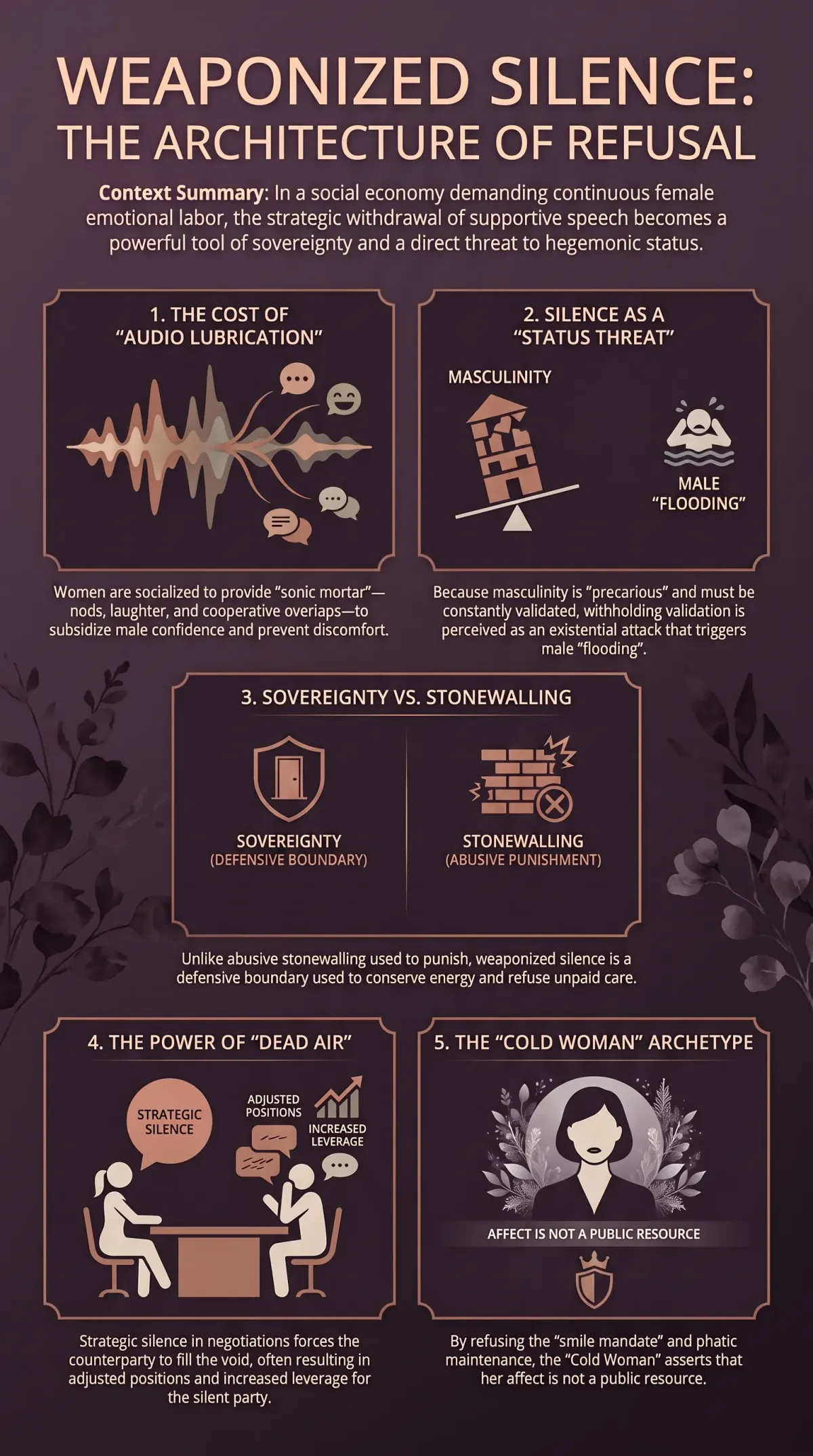
Watch a conversation between a man who is holding forth and a woman who is listening, and count the sounds she makes. The “mm.” The “right.” The half-laugh at the joke that didn’t land. The small “yeah, no, totally” she slots into his pause so the pause never becomes a gap.
None of that carries information. Strip every one of those tokens out and the content of the exchange is unchanged. They aren’t there to say anything. They’re there to keep the thing moving.
Deborah Tannen’s sociolinguistics describes the general phenomenon: the phatic noise that keeps a conversation flowing and its participants comfortable. This project calls it audio lubrication. Set it beside Arlie Hochschild’s account of the managed heart, the paid smile of the flight attendant, and what it is becomes obvious. It is work. Somebody is doing it, it costs something to do, and nobody is paying for it.
What the noise is actually for
Lubrication is a mechanical term and it’s the right one. In a machine, lubricant sits between two surfaces so they don’t grind. It doesn’t make the machine go. It makes the machine’s own friction imperceptible to itself.
That’s what the “mm” does. A person speaking without any response has to notice their own effect on the room. Every few seconds they’re getting live data about whether they’re interesting, whether they’re right, whether anyone is still there. The stream of small affirmations removes that data. It lets a speaker experience himself as fluent, compelling, obviously worth the floor — not because he is, but because the feedback channel has been filled in advance with yes.
The labour is more precise than it looks. To place a supportive noise correctly you have to track the speaker’s cadence, predict where the beat falls, and land something short enough that it reads as encouragement rather than a bid for the floor. Say too much and you’ve interrupted. Say the wrong thing and you’ve disagreed. So the tokens get stripped of content until they’re pure rhythm — a backing track, played live, by someone who has to listen closely enough to keep time and isn’t permitted to play a note of her own.
Meanwhile she is also suppressing whatever she actually feels, which may be boredom. That suppression is a second job running underneath the first.
It has a text version now, and the text version is more explicit because you can see the tokens on the screen. The exclamation marks. The emoji. “Just wondering if —”. “No worries if not!” “Sorry, quick question.” A message that says what it needs to say, ends in a full stop, and offers nothing else is read as cold. Not incorrect. Cold. Which tells you the affect was never optional; it was part of the transaction.
The rule you only notice when it breaks
Here’s the test. Stop.
Not a dramatic stop. Just don’t supply the noise. Don’t nod. Let the sentence end and let the air stay empty for three seconds.
Something happens, and it happens fast, and it is out of all proportion to a person simply not making a sound. Within about two exchanges you’ll get a version of: You’re quiet. What’s wrong? Are you mad at me?
Those are not questions about her. They are requisitions. Each one is a demand that she resume production — reassure me, validate me, or at minimum file a report on your internal state so I can regain control of what this interaction means. And notice the framing: the silence is a problem she has introduced and is now responsible for resolving.
The reason a missing “mm” can generate that much heat is that silence isn’t landing on neutral ground. Judee Burgoon’s expectancy violation theory is the useful frame here: every interaction runs on expectancies, predictions about how the other person ought to behave, and a breach of one doesn’t read as neutral — it spikes attention and sets off a scramble to work out what it meant. The expectancy loaded onto “woman in a conversation” is accommodation: responsive, warm, attentive to what the other person needs. Behaviour that fits an expectation is invisible. Behaviour that breaches one is an event. So her silence isn’t received as she happens not to be speaking. It’s received as she is withholding something from me, which presupposes it was owed.
The face works the same way. A woman with a flat, neutral expression is not perceived as neutral; she is perceived as hostile, and the culture has a name ready for it. The smile is visual lubrication and its absence is read as an act.
Why the reaction is so large
The size of the response is the interesting part. Nobody’s heart rate goes to a hundred over a missing syllable unless something more load-bearing than a conversation is being defended.
The theory that accounts for it is precarious manhood — the argument, in the social-psychology literature the chapter draws on, that manhood is not a state you arrive at and keep but a social status, hard won and easily lost, requiring continuous public demonstration, where womanhood is more often treated as something that simply happens to a body. Manhood has to be re-won, which means it has to be re-witnessed. The same literature is where the finding comes from that men whose masculinity is threatened tend to respond with compensatory aggression.
Which makes the withdrawal of witness an attack. Not metaphorically — functionally. If your standing depends on being visibly granted attention by the person culturally positioned to grant it, then her going quiet doesn’t hurt your feelings. It removes the prop.
And the removal is revealing, which is worse. The lubrication was concealing a dependency. A man mid-flow experiences himself as self-generating: he has ideas, he articulates them, the room follows. Take away the affirming noise and the actual structure surfaces — that the fluency was being manufactured jointly, and one party was doing it for free.
There’s a physiological layer under it. John Gottman’s term for what happens when a person is overwhelmed in conflict is flooding — heart rate over a hundred, adrenaline up, the reasoning part of the brain effectively offline — and his finding is that men flood at a lower threshold than women. Silence is ambiguous, and ambiguity in a state like that gets read as danger. He floods, and then he lashes out, and the lashing out is the last thing he can still do.
That’s the mechanism. The silence doesn’t create the dependency. It just stops hiding it. Everything that follows — the interrogation, the sulk, the escalation to what is your problem — is the sound of a system trying to restore a subsidy it had stopped noticing it received.
The extreme end of this is legible in public. There is an entire online culture organised around the conviction that women withholding attention constitutes a deprivation, that a reply, a date, a look, is a resource being unjustly withheld from men entitled to it. That is not a fringe distortion of the dynamic. It’s the dynamic with the volume up. Underneath it is the same premise as why are you being so quiet: her attention was already mine, and its absence is a theft.
The distinction that has to hold
This has an obvious failure mode and I want to name it, because the argument is worthless without the boundary.
There is a use of silence that is straightforwardly abusive: shutting down a partner mid-conflict, refusing to engage with a legitimate grievance, going blank to punish someone or to escape accountability. Gottman calls it stonewalling and counts it among the four horsemen: it’s real, it’s corrosive, it predicts relationships ending, and by his figures around eighty-five percent of the people doing it are men. Nothing here defends it.
The difference isn’t the behaviour. It’s the direction of the power and the nature of the request. Stonewalling is the stronger party refusing to acknowledge the weaker party’s existence, aimed at someone asking to be met. What I’m describing is the party doing unpaid service work declining to keep doing it, aimed at someone consuming it as of right. One says you do not exist. The other says I am not going to pretend this is interesting.
The second is a boundary. It only reads as an attack from inside an entitlement.
Attention is not a commons
Audre Lorde wrote that your silence will not protect you, and the essay it comes from — “The Transformation of Silence into Language and Action” — is usually read as a mandate to speak: name the harm, put it into language, accept that self-revelation is fraught with danger and do it anyway. It is good wisdom and I am not arguing with it.
I think it holds when speech will land somewhere it can do work. It doesn’t hold when the speech will be metabolised by the thing it’s aimed at: your tone policed instead of your point answered, your anger read as proof of the stereotype, your account of your own pain absorbed and returned as evidence about your instability. In that room, speaking is a donation of material to a system that will only use it against you.
Which is why coldness functions. Give a biased observer no affect to interpret and there’s nothing to project onto — no tone to characterise, no reaction to caricature. Withhold the emotional data and you become harder to file. Illegible, and therefore harder to govern.
That’s the whole claim, and it’s smaller and harder than it sounds. Your attention is not public land. It is not a common grazing ground for anyone who wants validating. It’s yours, and the fact that declining to hand it over registers as violence in someone else’s nervous system is information about the arrangement, not about you.
Let the air stay dead. Watch what comes to fill it. That’s the shape of what you were carrying.