The Boredom Strike
The attention economy doesn't want your attention. It wants your arousal. Boredom is the one state it can't sell, which makes it a labour tactic.
Listen while you read · 22:01
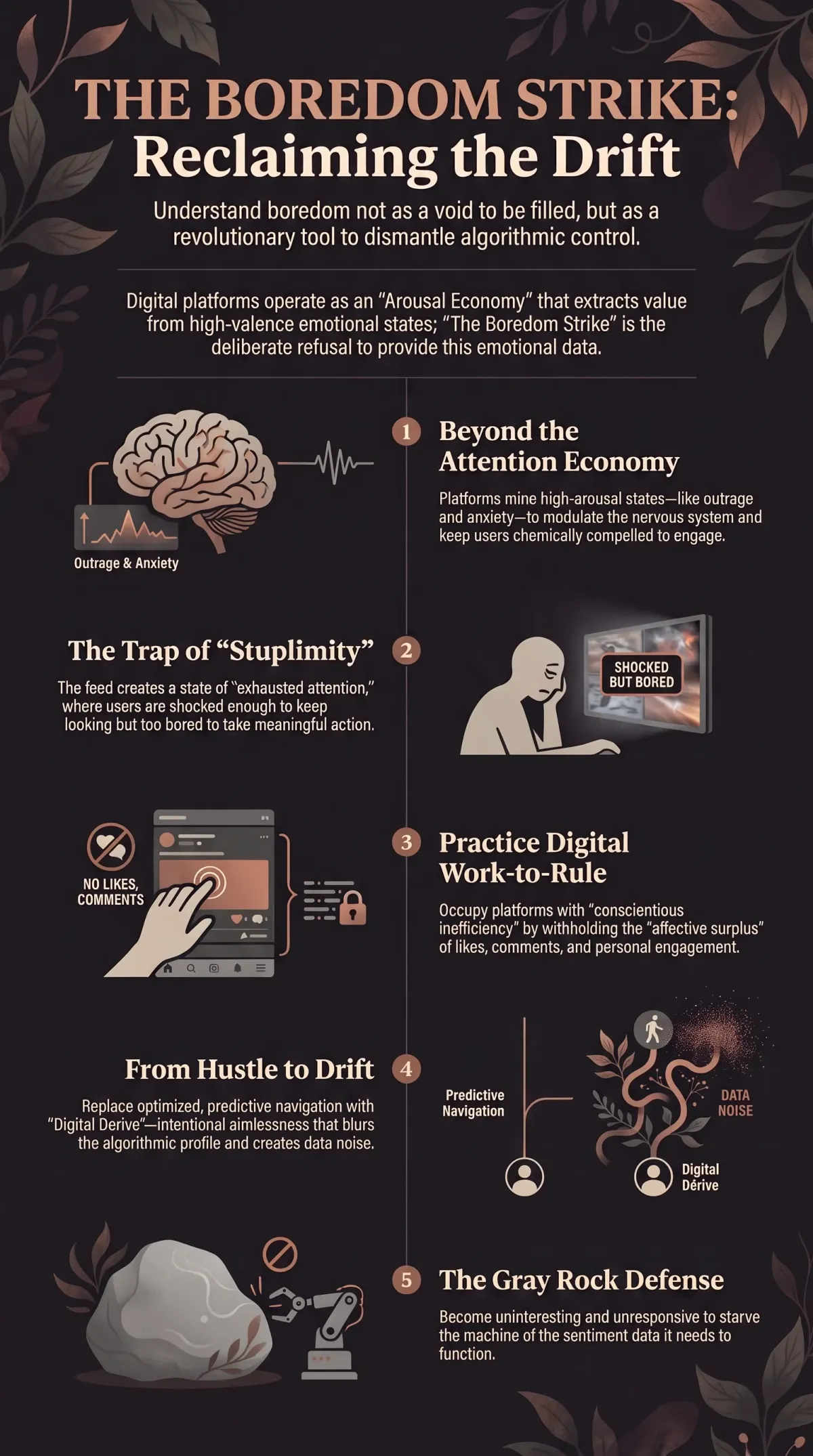
We call it the attention economy, and that’s the wrong name. Attention is just the delivery pipe. The thing being mined at the other end is arousal — how hard your nervous system spikes, in which direction, and how reliably it does it again tomorrow.
You can tell because of what the system does with calm. A contented user is worth almost nothing. A furious one is worth a great deal. No one had to decide that; the ranking model simply measured dwell time and drew the obvious conclusion.
Once you see the commodity clearly, the tactic follows. If arousal is the product, then withholding arousal is a strike.
The machine runs on being wrong
The mechanism is older than the platforms. Your midbrain runs a constant prediction: here’s what I expect to happen next. When reality beats the prediction, you get a burst of dopamine. When it falls short, you get a dip, felt as disappointment, felt as one more scroll. The size of the signal tracks the size of the error.
Crucially, a fully predicted reward produces nothing. If you knew exactly what the feed would show you, opening it would do nothing chemically at all. The whole apparatus depends on you not knowing.
So the feed ends up unpredictable in the way a slot machine is unpredictable. The comparison isn’t mine — the psychology of variable-ratio reinforcement is the same in both, and pull-to-refresh is the lever. The next item might be a validation or a war crime, and I’d argue the fact that you can’t tell in advance isn’t merely a side effect of ranking content well. You aren’t scrolling because you’re enjoying it. You’re scrolling to resolve an error the system keeps re-opening.
Layer negative emotion on top and the intensity climbs. The brain prioritises threat information over safety information, which is a survival mechanism and not a design flaw. Saturate a feed with status threats and moral outrages and you aren’t persuading anyone of anything — you’re leaning on that mechanism until looking away gets physiologically hard. On the evidence of what the ranking models reward, outrage is the highest-yield ore in the mine.
Not all boredom is the same
Here’s where it gets subtle, and where most digital-detox advice goes wrong. The feed does not remove boredom. It manufactures a particular kind and traps you in it.
Sianne Ngai has a word for the sensation: stuplimity. Stupid plus sublime. The classical sublime is a confrontation with the infinite that terrifies you and then elevates you. Stuplimity is a confrontation with a very large heap of finite junk that just wears you down. A genocide, a cat, a shoe advert, a friend’s engagement, all in eleven seconds, none of them connected to any of the others.
That state is shock and boredom fused together, and it’s perfect for the platform. Shocked enough to keep looking. Bored enough not to get up and do anything about it. A genuinely mobilised person would close the app and go somewhere. A stuplime person stays, thumb moving, agency obstructed, feeling nothing in particular for four hours.
Against that stands a different animal, what Byung-Chul Han calls profound boredom, and what I’d call radical boredom: the boredom of a person with nothing coming in. Not a lull between stimuli — the actual floor. It’s uncomfortable at first because it is literally a withdrawal, the nervous system complaining about a baseline it was trained up off. Sit past that and something reopens. Attention that can hold one thing for an hour rather than a hundred things for nine seconds each.
Han’s diagnosis is that we’ve lost the instinct to exclude — the ability to say no to a stimulus. We answer every notification because it arrived. Radical boredom is the practice of not reacting, retrained until it’s available on demand.
And boredom does something anger can’t. Anger implies a villain and a plot, which is flattering. Boredom just reveals the banality of the thing. Let yourself be genuinely bored by the feed instead of engaged by its manufactured urgency and you see it for what it is: a repetitive machine, running the same four moves, forever. Boredom strips the glamour off. That’s a diagnostic instrument.
Work-to-rule for the algorithm
If your attention is labour — and it is, since it’s the input someone else sells — then withdrawing it is an industrial action. Which means the tactics already exist, worked out by people with far more at stake than us.
In 1889 the Glasgow dockers wanted a ten percent rise. The employers refused and brought in farm labourers as scabs, who were slow and clumsy and dropped things. The union didn’t call a walkout. It told the members to go back to work and work exactly as badly as the scabs had. Every safety rule followed to the letter, every knot checked, everything moving at an agonising crawl. Within days the contractors were begging them to speed up, and the rise was granted.
That’s the shape. Not deletion — deletion is a walkout, and it mostly isolates you while the machine carries on. Instead: stay, and be conscientiously useless.
The Italian version is sciopero bianco, the white strike, work-to-rule: do precisely what the contract requires and not one thing more. Withdraw all discretionary effort and goodwill. Every platform runs on discretionary effort. Nobody is contractually obliged to like, share, quote, or comment. That’s the unpaid shift, and it’s the entire product.
So the digital work-to-rule is: keep the account, provide zero affective surplus. Read what you came for. Don’t react. Become uninteresting — offer no emotional surface for the prediction machinery to grip. It feeds on reaction and it does not care which direction the reaction points. Give it neither and it starves on your row of the ledger.
The second tactic is drift. The Situationists had the dérive: drop your usual reasons for moving through a city and let the terrain pull you. The algorithm is an urban planner, and a fairly brutal one, laying out the desire lines that lead where it wants you. Drifting breaks them. Click what wasn’t suggested. Go to the archives, the old blogs, the sites with no ad tech on them. Jump from fourteenth-century pottery to a regional newspaper in a country you’ve never visited. Every unpredicted move raises the prediction error and blurs the profile.
There’s a physical analogue, and I’ve written before about how hostile architecture removes benches so nobody loiters. Platforms do the same thing to exits. Drift is loitering, restored.
Who was doing the lubricating
I’ve been writing as though attention is extracted evenly. It isn’t, and leaving that out would gut the argument.
The economy doesn’t just want responsiveness in general. It capitalises on a specific socialisation — the training of women to be responsive, empathic and available. Deborah Tannen’s sociolinguistics describes the phatic work that keeps a conversation frictionless: the nods, the “uh-huhs”, the smiles — what this project calls audio lubrication — whose function is to manage the emotional comfort of whoever else is talking. It translates onto a feed almost without modification. The expectation is that women will manage the emotional tone of the thing — soften, affirm, respond, keep it pleasant.
So the demand for arousal arrives already gendered, and it arrives as a double bind. Too much of it and she’s hysterical. Too little and she’s cold, or a bitch. What the algorithm wants is a Goldilocks band in the middle: high enough to generate data, modulated enough to stay consumable. There is no setting on that dial that isn’t work, because the work is the dial-watching.
The cost compounds for young women in particular, on whom the pressure is to curate a “becoming” self — a future-oriented, optimised version of womanhood, always in progress, never arrived. The researchers’ word for the underlying logic is indebtpending: mortgaging present attention against a status that stays permanently deferred. Refusing to become — just being, in a state of boredom, not in progress toward anything — is a default on that debt.
You can watch the counter-move being made in public. There is a whole genre of content aimed at teenage girls on the theme of what to do when you’re bored, and its consistent framing is that boredom is a management problem: here is a list, here are some activities, here is how to fix the feeling. The void gets filled with busy work before it can do anything. Which is precisely the point — a girl who reaches actual radical boredom might notice the structural emptiness of the platform she’s on.
Sianne Ngai’s argument about ugly feelings is the one that makes this legible. Boredom isn’t just unpleasant; it’s an index of obstructed agency, a feeling that registers the fact of being blocked. Manage it away and you’ve disappeared the signal along with the discomfort.
So the feminist version of the strike is not to solve the boredom. It’s to fail to manage it. Let the dead air sit. Don’t smooth it over, don’t fill it, don’t apologise for it. The obstruction that was being quietly absorbed becomes visible the moment somebody stops absorbing it — which is also, as it happens, what happens when a woman simply stops making the noise.
Why this actually costs them money
None of this is only self-care. Low arousal is a hole in the balance sheet.
Advertising needs a keyed-up nervous system to work at all. People have long since developed the reflex of not seeing peripheral content, and getting through that filter requires shock — motion, alarm, colour. One study of ad effectiveness put immediate recall of high-intensity emotional ads at 60.4 percent against 22 percent for low-intensity ones — a single study, but the direction is what matters. And a relaxed person is measurably more likely to do nothing, to keep the status quo, to not click.
A user practising radical boredom generates no behavioural surplus worth training on. They don’t respond to the nudges. They’re technically present and economically absent — logged in, consuming bandwidth, producing nothing sellable. The single least profitable object in the system.
That’s what makes it a strike rather than a lifestyle. Individually it looks like nothing. It’s meant to. So did working slowly on the Glasgow docks.
My boredom is my own
The demand underneath all of this is that you be interesting, visible, and productive at all times, and that any gap in you be filled by someone with something to sell. What gets evacuated in the process is interiority — the part of you that isn’t performing for an audience that isn’t there.
Boredom is not an absence of content. It’s the presence of the self, arriving once nothing else is being pumped in.
Earlier in this series I was writing about the body’s visibility — who gets seen, and what the seeing costs. This is the other axis: the body’s tempo. To be ungovernable is to move at a speed the machine can’t track. Rot, in the sense of being permitted to go unoptimised. The revolutionary subject here isn’t someone shouting from a barricade with their phone out. It’s someone on a park bench watching birds, paying attention to nothing but the world.