The Analog Insurrection
Disconnection used to be the default. Now it is a luxury good, and the price of staying unreadable is quietly sorting us into two classes.
Listen while you read · 29:26
For twenty years the problem was getting people online. The digital divide was a gap in access, and closing it was straightforwardly good: connect the disconnected, and they get jobs, services, a vote that counts.
That gap closed, and then it inverted. Connectivity stopped being a resource you were granted and became a condition you are held to. A growing share of ordinary transactions — applying for work, booking an appointment, paying for parking — now assumes a phone that reports your position, and the alternatives are being withdrawn rather than maintained. Being online is not an opportunity any more. It is the terms of service for existing.
Which means the scarce thing is now the opposite. The ability to be unreadable, unlocatable and unrecorded has quietly become a luxury good — and like every luxury good, it is sorting people.
The house is the sensor
Start with the mechanism, because the mechanism is not sinister and that is the point.
A smart device collects two kinds of data. The first kind it needs: your thermostat has to know the temperature. The second kind is everything else it can get while it is there — when you wake, how many people live with you, how often the fridge opens after midnight. That second kind is the product. It gets fed into models that predict what you will do next, and predictions about people are sold.
Nobody in that chain has to want anything bad for you. The system is not interested in your soul, only in your predictability. A regime that wanted to change what you believe would have to argue with you. This one just needs you to be forecastable enough to sell forward.
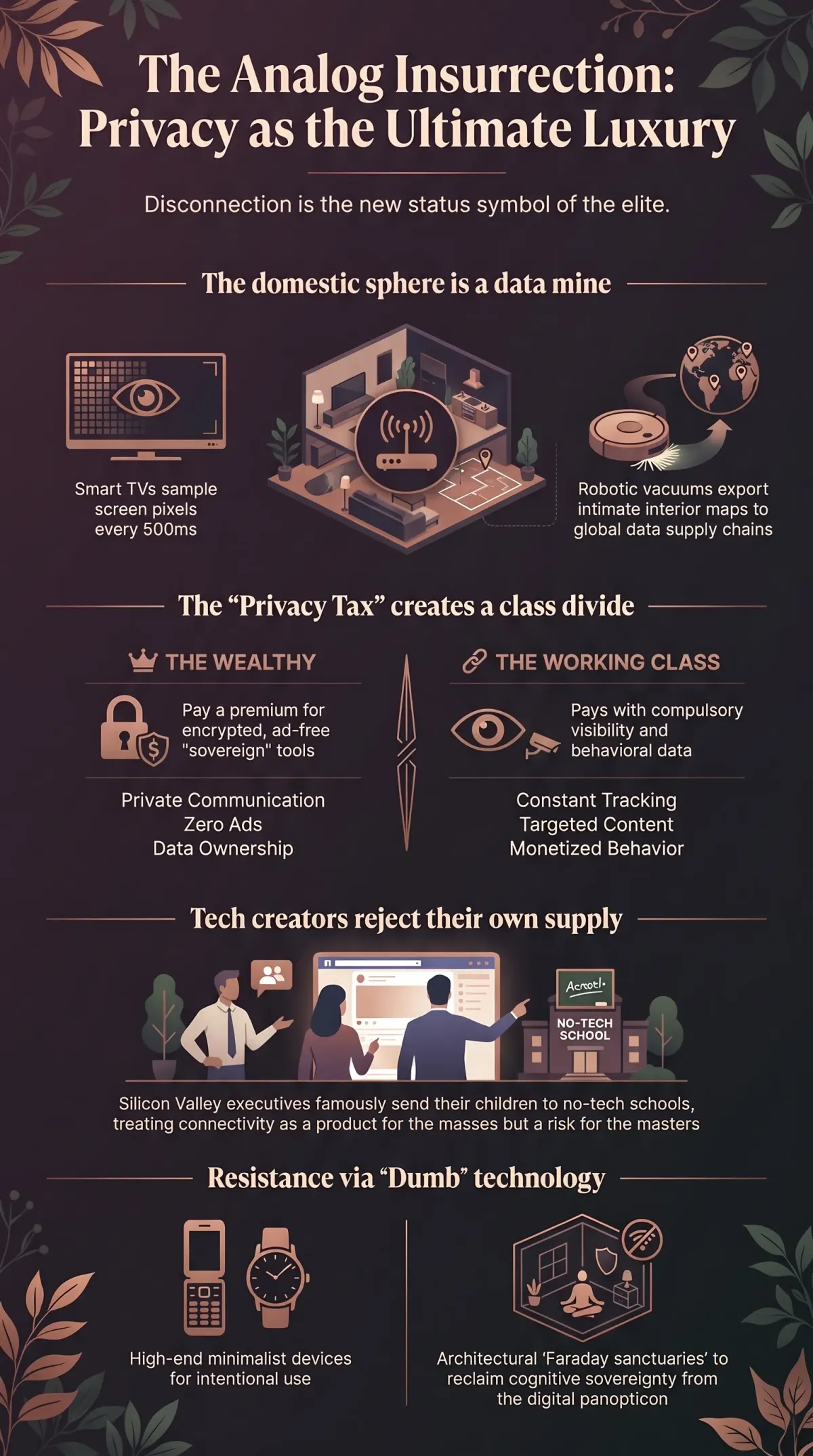
The specifics are more banal than you’d hope. Vizio settled with the FTC in 2017 over exactly this: its sets sampled what was on screen second by second, fingerprinted it, and sold the viewing histories of eleven million televisions, matched to household identifiers. Not every manufacturer does the same thing to the same degree, and the practice is now usually buried in a consent screen rather than run silently. But some TV makers have said outright that the data earns more than the hardware, which is why a large panel can be sold at or below cost. It is not a television with a spying feature. It is a subsidised sensor with a picture on the front.
The robot vacuum is a mapping unit. It knows your floor plan, your furniture density, whether there are children. A batch of images from such devices — including a woman on a toilet — ended up circulating among contract data labellers on the other side of the world. Those were pre-release development units given to paid testers who had agreed to data collection, not ordinary machines in ordinary homes, and the distinction matters. What it shows is not that your vacuum is uploading you, but what the training pipeline behind it requires, and how thin the wall is between a consent form and a stranger seeing your bathroom. The home robot that moves and has a face maps something else again: it identifies people, sorts them into household and stranger, and patrols.
In every case, extraction is the default and privacy is a setting. You can turn most of it off. You have to know it exists, find it under a submenu named something like Smart Interactivity, and do it again after the next firmware update. Privacy-by-effort is a way of granting privacy only to people with the literacy and the spare hours, while keeping the consent paperwork clean.
Nobody said no to you
The old picture of surveillance had a boot in it. This one has a discount.
You were not coerced onto the grid. You were invited, repeatedly, in a friendly tone, and every step was genuinely convenient. That is what makes it hard to describe as oppression, and it is why the standard response is not anger but a shrug. Digital resignation is the name for that shrug: not agreement, but the settled belief that objecting is pointless and opting out is social suicide. Companies do not need your consent if they can manufacture your fatalism.
What is being taken is not really data. It is interiority — the backstage. A person needs somewhere they are not being read: a room, an hour, a thought that leaves no record. Freedom has always required a shadow to stand in. When the speaker hears tone and the ring scores your sleep and the watch knows your resting heart rate, the shadow closes. You are lit from all sides, permanently, by devices you bought and love.
Sleep was the last thing capital could not use. You cannot work, buy or scroll while unconscious, which made eight hours a night the largest remaining unmonetised territory on earth. Note what happened next: sleep became a metric. A score in the morning, a streak to protect, a thing to optimise. The final refuge got converted into performance.
Only the rich get to rot
Here is where it turns into a class question rather than a taste question.
Privacy is now a product with a price, and the price is regressive. The subsidised phone comes preloaded with harvesters you cannot remove; the expensive one sells you the ability to refuse tracking as a feature. The free mailbox reads you; the paid one encrypts you, costs more, and gives you less storage. Every privacy-respecting alternative asks you to pay in money or convenience, which are exactly the two things people at the bottom have least of.
At the top of the market this stops being consumer software and becomes staff. Concierge cybersecurity firms scrub their clients out of data broker databases on retainer, harden their home networks, keep an incident team on call. Reputation firms suppress the search results, issue the takedowns, dilute the record. These services cost thousands a month, and what they buy is not secrecy exactly. It is the right to rot — the right to have your past fade, to stop being the person you were at twenty-three.
Human memory forgives by decaying. Digital memory does not decay, so a mugshot, a bankruptcy, a bad night with a camera in it stays as present as this morning. Everyone is now judged against the totality of their record instead of their current character. And you can escape that — you can buy organic forgetting back — if you can afford the firm. Which produces a society where only the wealthy are permitted to change.
The people who build all this understand it very well. The most legible signal in the industry is where its executives send their children: to schools that ban screens and teach with paper, mud and hands. They do not believe their own product is neutral. They just don’t sell to their own families.
Friction as a security feature
So there is a counter-movement, and it is not Luddism. It is tactical.
The tell is that the dumb phone is now expensive. A minimalist handset from a design studio can cost more than a budget smartphone while doing a fraction as much, and people buy it precisely for the fraction. What you are paying for is the absence of surface area: no GPS history, no app SDKs leaking to third parties, no microphone waiting for a wake word it will sometimes mishear. It is worth being precise about what this buys, because the marketing is not. A dumb phone still produces call records, messages and cell-site location data, all of which are routinely obtainable by law enforcement. What shrinks is the commercial surface — the continuous behavioural exhaust sold onward to brokers — not your visibility to a court order.
That price also signals something ugly and honest on the buyer’s behalf: I do not need to be reachable, nobody is dispatching me through an app. Refusal is easiest for people whose income does not depend on being pageable, which is another way of saying the insurrection has a class ceiling. It is not disproved by that. It is just clarified by it.
The interesting part is that the tactics get physical. Conductive paint that kills RF through a wall. A silver-threaded canopy over the bed so nothing transmits while you sleep. A box lined with mesh that is just an airplane mode you can hold. My favourite is a small parasitic device that sits on top of a smart speaker and pours white noise into its microphone continuously, deafening it, lifting the noise only when it hears a wake word of your choosing. It does not ask the manufacturer for a privacy mode. It simply takes the microphone back.
All of these reintroduce friction on purpose. Frictionlessness is not a gift to you; it is the removal of the pause where you might have decided otherwise. The gap, the delay, the effort — that is where agency lives, and a system optimised to eliminate friction is optimised to eliminate the moment of choosing.
The luxury of silence
I don’t think a paper notebook defeats surveillance capitalism, and I’m suspicious of any politics you can buy in a nice matte finish. Individual refusal, priced the way it is, will always be available to the people who need it least.
But the direction is worth naming clearly. The coming fight is not over who can get online. It is over who is allowed to leave. Without something structural — hard limits on behavioural extraction, an enforceable right to have your record fade — privacy settles into its place as a premium tier, and everyone else lives transparent by default because that is the free plan.
The body that refuses to be a data point is the one this whole project is about. Right now, that refusal costs money.
The full chapter, with the research and sources behind it, is here: The Analog Insurrection →