The Ghost in the City
A city redesigned so that pausing reads as a fault condition, and what that costs the people whose bodies need to stop.
Listen while you read · 12:40
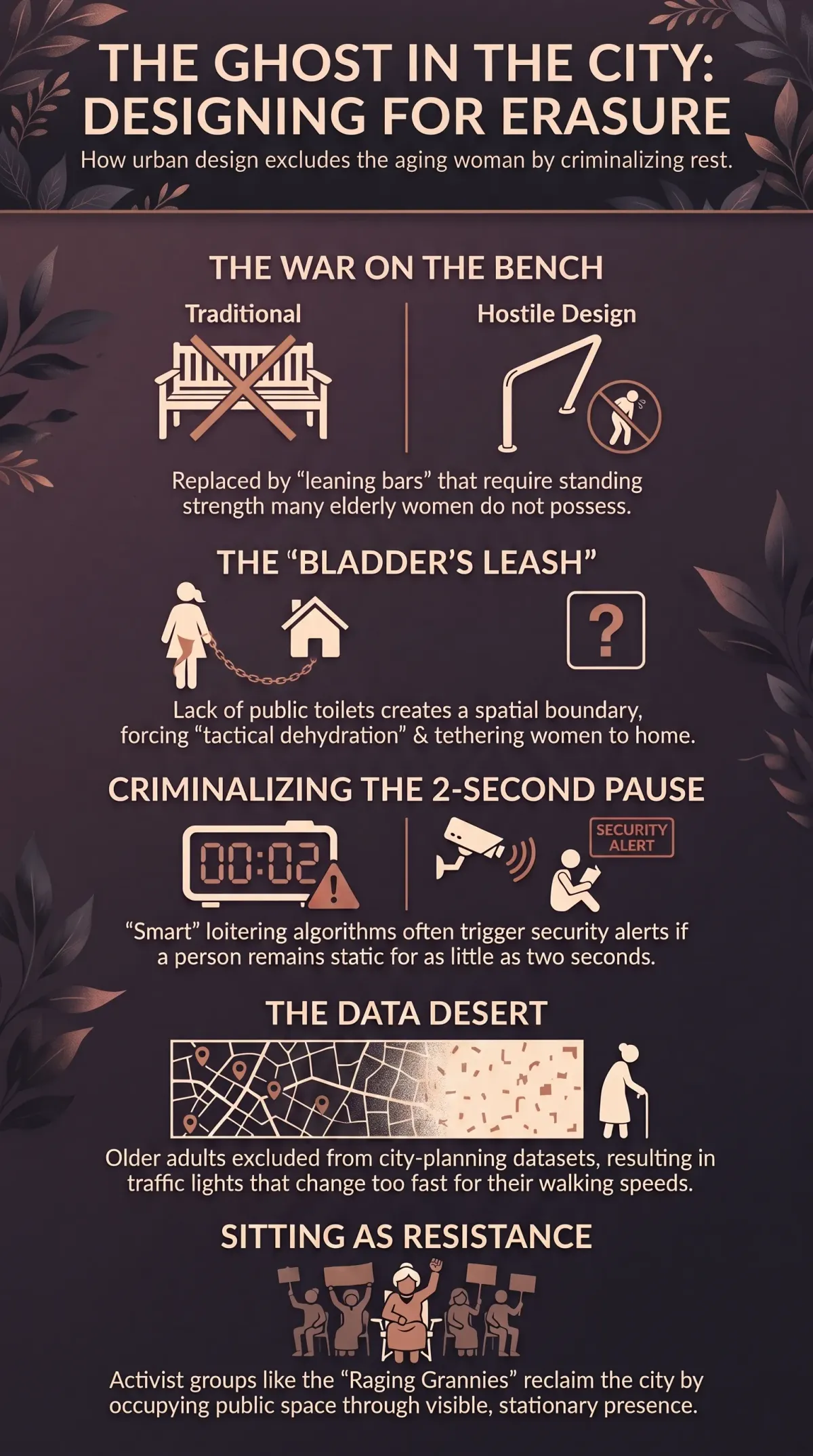
Go and look at your nearest bus stop. If it was refurbished in the last decade, there is a decent chance the seat is gone and something else is in its place: a narrow rail at hip height, angled slightly, polished stainless. It is called a leaning bar. The trade name is ischiatic support, which means it holds your sit bones and nothing else.
It is furniture in the sense that a speed hump is a road. It exists so that the council can say seating was provided while making it physically impossible to stay.
A leaning bar works if you are forty and healthy and waiting four minutes. It requires you to hold your own weight through your quadriceps and your lower back, keep your balance without a backrest, and reach a fixed height standardised somewhere near the average adult male hip. If you have arthritis, or reduced muscle mass, or any of the balance decline that comes as standard with age, it is not rest. It is a slightly less demanding form of standing.
So the woman who would have been at that bus stop is not at that bus stop. She is at home. She did not decide that. The furniture decided it for her.
This is the pattern I want to name, because once you see it you cannot stop seeing it. Cities are being re-engineered around a standard human — young, mobile, able-bodied, on the way to somewhere, spending money at the other end. Everyone who deviates from that profile gets reclassified as friction. And the deviation that matters most here is the simplest one in the world: needing to stop.
The bench was infrastructure
We stopped treating the public bench as infrastructure and started treating it as a liability, and almost nobody noticed the reclassification happening.
A bench is one of the few genuinely egalitarian objects a city produces. It costs nothing to use, it asks nothing of you, and you do not have to buy a coffee to earn it. For an older person it is not amenity, it is a mobility device — it breaks a journey that is impossible in one go into a series of manageable segments. Take the benches out and you have not made the street slightly less pleasant. You have made the street unreachable for a whole category of person, without ever putting up a sign.
Benches came out because they attract loitering, which is the polite municipal word for people whose presence someone has complained about. Rough sleepers, mostly. Teenagers. The design response was armrests that are not armrests, slants that shed you gently forward, and finally the leaning bar. Councils call this vandal-proof design. It is more accurate to call it human-proof: it assumes the human body is a source of wear and damage to be engineered out.
The collateral is not incidental. When you remove the ability to sit, you make the public realm conditional on stamina. Public life becomes a fitness test, and the pass mark keeps rising.
There is an old moral logic hiding underneath this. The upstanding citizen is a real phrase with a real history — upright meant industrious, vigilant, employed. Sitting meant idleness and vice. The modern city has quietly rebuilt that morality in steel. The standing citizen is the commuter and the consumer. The sitting citizen is the loiterer, the vagrant, the person with nowhere to be. Design the street so that only standing is possible and you have legislated a morality without ever passing a law.
The other tether
The bench governs how long she can be out. Something else governs how far.
Call it the bladder’s leash. If you rely on public toilets, the radius of your independent life is exactly the distance you can travel from a known, open, accessible one and get back. Not the distance you can walk. The distance you can walk with that constraint attached.
It falls hardest on women and hardest again on older women, for reasons that are physiological and entirely undramatic and almost never designed for. Women take longer, need cubicles rather than urinals, and need more of them to move the same number of people through; provision is planned by floor area or fixture count rather than throughput, which produces the queue everyone has seen and nobody has fixed. Add the higher rates of incontinence that come with age and the leash gets very short.
The workaround people invent is grim and common enough to have a name: tactical dehydration. You stop drinking before you leave the house. Older people, already at higher risk from dehydration, deliberately underdrink so they can go to the shops. That is what it costs to attend public life in a city that decided toilets were a budget line rather than infrastructure.
Meanwhile the toilets that closed have been replaced by cafés and department stores, which is a privatisation of a bodily necessity. To urinate, buy something. If you are on a pension, the city now charges admission at the door of your own bladder.
The algorithm learns to hate stillness
The physical city pushes her out. The digital layer over the top of it finishes the job, and this is the part that is genuinely new.
Loitering detection is a standard feature in commercial video analytics. It sits in transit hubs, malls, car parks, ATM lobbies. Its logic is brutally simple: movement is purposeful and therefore good, stillness is suspicious and therefore bad. You draw a zone on the camera view, you set a TimeThreshold, and the system raises an alert when someone stays inside the zone longer than that.
Read the vendor documentation and the thresholds are startling. Configurable ranges commonly start at two seconds. Two seconds is not casing a shop. Two seconds is catching your breath, shifting a shopping bag to the other hand, or checking which platform you want. The camera does not model a reason for the pause. It models the pause.
This is hostile architecture with no hardware. The leaning bar prevents sitting physically; the loitering algorithm penalises stopping statistically. Same objective, cheaper deployment, and it can be rolled out over infrastructure that already exists.
Worse, the systems are trained on what normal movement looks like, and normal was learned from footage of the working-age population going about its business at pace. A slow gait, a meandering path, a person who stops twice on the same block — these are statistical outliers, and outlier is the exact input an anomaly detector is built to flag. There is no malice anywhere in the pipeline. There is just a definition of normal that was never audited, hardened into an alarm.
The feedback loop closes itself. She gets approached by a guard the algorithm dispatched, or startled by an automated voice telling her to move along, and she does not go back to that place. The system reports a reduction in loitering. It has, technically, succeeded.
The same blindness runs upstream in the data. Traffic signal timings assume a walking speed of about 1.2 metres per second, derived from healthy working-age adults. If you walk slower than that, the crossing you were promised is a crossing you cannot finish. And because older people are underrepresented in the phone and app telemetry that increasingly drives planning decisions, the friction they experience never shows up in the dataset that would justify fixing it. They live in a data desert. The city optimises itself, carefully and continuously, for a user who does not include them.
What refusing looks like
None of this is received passively, which is the part the theory usually undersells.
There is a quiet version. People bring folding chairs. They sit on low walls, planters, the edges of raised beds, and they use leaning bars in ways no product designer sanctioned. In a city that mandates motion, staying put is a political act — a refusal to accept that you must keep moving to remain legitimate.
There is a loud version. The Raging Grannies have been going since 1987, and their tactic is to weaponise exactly the invisibility that was imposed on them. Floral aprons, ridiculous hats, satirical songs, and a complete immunity to standard crowd control, because nobody wants the photograph of a police line moving on someone’s grandmother. They took the assumption that an old woman is harmless and turned it into access.
And there is the fix, which is not complicated. Put the benches back, with backs and armrests and a height an older body can rise from. Open the toilets and keep them open. Stop treating rest as an anomaly in the model, in the concrete and in the code alike.
A city that only works for people who never need to stop is not efficient. It is broken, and it has simply arranged not to see who is missing.