The Glass Cage
The demand that you be readable is the demand that you be governable. On legibility, the trap of visibility, and why opacity is the freedom left.
Listen while you read · 20:32
In the late eighteenth century the Prussian state had a problem with its forests. A forest, to the people living beside it, was firewood and fodder and berries and game and mushrooms and a place to hide. To a tax assessor it was noise. You cannot levy a berry. You cannot forecast a mushroom.
So the state built a forest it could read. Clear the underbrush, plant one species — Norway Spruce — in straight rows at fixed spacing, and now a man with a notebook can stand at the edge and calculate the yield of the whole thing without walking into it. This was called scientific forestry and it was, for about a century, a triumph.
Then the forests started failing. Scott’s reading is that the underbrush had been doing something — holding soil, cycling nutrients, supporting the insect life the system depended on — and that the simplified forest, stripped of that, became sickly and vulnerable to pests and storms. The word reached for here is Waldsterben, forest death, though it now carries a much larger and more contested argument than a century of spruce plantations can settle. Take it as the shape of the failure rather than a verdict on its cause: a monocrop in rows, perfectly countable and much less able to survive a bad year.
I keep coming back to that story because it is the clearest description I know of what a platform does to a social life.
Legibility is the whole game
James C. Scott’s term for what the state wanted is legibility. Not knowledge — legibility. A pre-modern state was mostly blind: it could not tax, conscript or police effectively because local life ran on unstandardised measures, inherited customs, names that changed with circumstance. Surnames, the census, the cadastral map, standard weights all made that mess readable, and none of them is a neutral instrument. Each is a decision about which parts of a human life count and which are cleared as underbrush.
The same operation runs on a feed. Human interaction is context-dependent, full of weak ties, silences, tone, the thing said only because of who else was in the room. That is illegible to an advertiser. So the platform clears it and replaces it with standardised units: the like, the repost, the react. The like button is the Norway Spruce. It reduces an unbounded emotional range to one countable signal, planted in rows, harvestable at distance.
And the harvest has a name too. Shoshana Zuboff calls it behavioural surplus — the residue of your experience, claimed as raw material. That phrasing matters. You are not the customer and you are not really the product either. You are the timber.
The difference between then and now is method, not intent. The twentieth-century state was deductive: it drew a grid and forced the territory to fit, and when the map disagreed with the ground the ground was bulldozed. The current arrangement is inductive. Nobody needs to make you standardise your name — they track a device identifier, a face print, a gait, and infer the pattern from the exhaust. The grid isn’t imposed any more. It’s derived. And the ambition has grown: the old state wanted to govern the present, this one wants to govern what you have not done yet.
The cage is made of glass, and glass works both ways
Here’s the shape of the thing. You sit in front of a screen that is transparent, responsive, smooth. It feels like a window. You are looking out at the world through it.
The world is looking in. And the asymmetry is total — you can see nothing of the mechanism, and the mechanism can see nearly everything of you. That’s a cage whose bars are invisible precisely because they are so well-lit. You don’t feel confined because everything you point at moves.
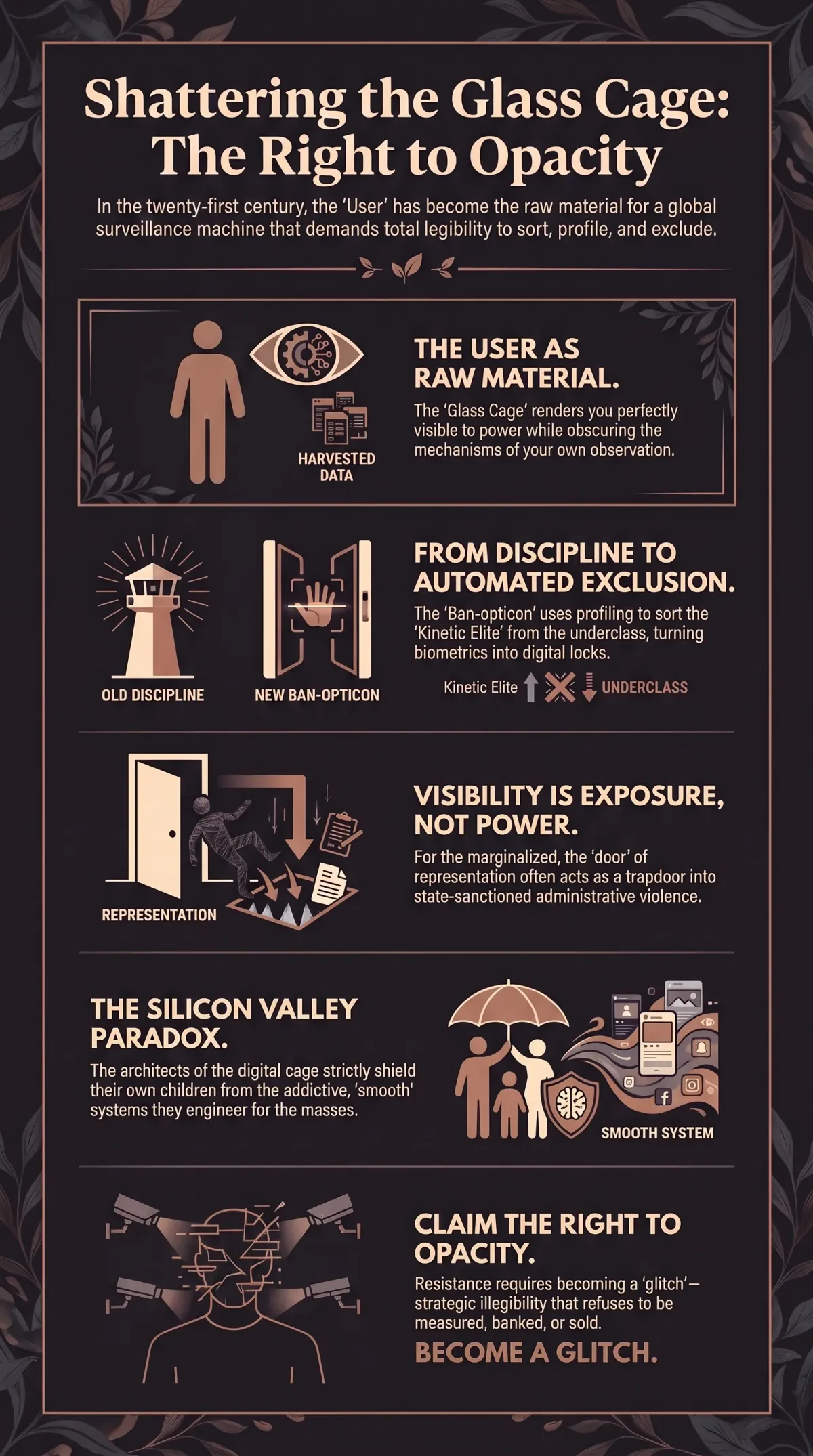
Foucault’s panopticon was about discipline: you might be watched, so you police yourself, and eventually you are returned to society corrected. That’s not what this is. The contemporary system is not trying to correct you. It sorts. Didier Bigo’s word for it is the ban-opticon — a machine whose output is not conformity but exclusion. It filters. It decides who moves freely and who gets stopped, and it decides on the basis of what you might do rather than what you have done. Correlate enough weak signals and you have a profile, and the profile authorises action in the present against a future that hasn’t happened.
Which produces two populations. For one, biometrics are a key: Global Entry, the fast lane, the door that opens before you touch it. Surveillance arrives dressed as convenience and the cage is a VIP lounge. For the other, the same biometrics are a lock. No-fly lists, credit denial, a benefits system that can’t parse your paperwork, a bank that won’t open an account. Same infrastructure, opposite valence, and which side you land on is a scoring decision you never see.
Visibility is not power
The liberal reflex says the answer to all this is representation. Be seen. Get counted. Being visible to the system is how you get protected by it.
I don’t think the evidence supports that.
Simone Browne traces surveillance back through the lantern laws — eighteenth-century codes in New York requiring Black, mixed-race and Indigenous people to carry a lit candle after dark if they were out unaccompanied. The law didn’t watch anyone itself. It deputised every white person on the street to watch, and it obliged the surveilled body to illuminate itself. Carry your own light. Make yourself readable on demand or be presumed a threat.
We do this now with a phone. Show your face to the scanner, keep the device on you, be locatable, or explain yourself. And the systems doing the reading do not fail evenly across everyone — they fail along the lines of who the training data was built around. When Buolamwini and Gebru audited commercial systems that classify a face by gender, the error rate on lighter-skinned men was under one percent; on darker-skinned women it ran to nearly thirty-five. That study measured classification rather than identity matching, but the mechanism it exposed — accuracy tracking the composition of the training set — is the same one that governs recognition, and the same populations sit at the wrong end of it. Older faces are a separate problem again, since ageing degrades the stability of the features the systems key on, producing its own class of people the machine cannot enrol. The failure takes two forms — a false match against a criminal database, or outright non-recognition, a face the machine cannot see as a face — and both land on the same people.
The trans case makes it sharper still. The period of greatest trans visibility in Western media coincided with a surge in legislative attack and administrative erasure. The anthology Trap Door names the mechanism: the door you’re invited through is a trapdoor. Come out, be recognised, be protected — and once categorised, be findable. Dean Spade calls the consequence administrative violence, and it is unglamorous and everywhere: it’s the paperwork, the checkbox, the mismatch between the document and the body. A TSA scanner requires an operator to press pink or blue before you step in. If your body doesn’t match the model’s prediction, the machine flags an anomaly, and the anomaly triggers a physical search. A rounding error in a database becomes a stranger’s hands.
Visibility, in a sorting machine, is a target designator.
Why the smoothness is the point
None of this would hold if the cage were unpleasant. It holds because it feels good.
Byung-Chul Han’s word is the smooth — the object that offers no resistance. The buttonless slab of glass. The infinite scroll with no stopping cue. The like, which permits agreement and nothing else. You cannot argue with a like button. You can press it or scroll past. Friction is where thought happens, and the interface is engineered to remove friction, which means it is engineered to remove the moment where you might have stopped.
That was the original bargain of user-friendliness, and it was a real bargain with a real cost. The graphical interface put you in a clean, well-lit room and hid the machine’s workings behind the wall. You got the ability to point at things. You gave up the ability to see how they worked. Every layer of convenience since has taken the same trade, and the capacity it replaces tends to quietly go: rely on turn-by-turn directions for long enough and the map you used to hold in your head stops being maintained.
The tell is what the architects do at home. Steve Jobs, asked whether his kids loved the iPad: they haven’t used it, we limit technology at home. Gates capped screens and banned phones until fourteen. The most fashionable school among Bay Area executives bans screens outright in the elementary years in favour of physical activity, knitting, mud and experiential learning. Facebook’s first president said out loud that the design goal was to exploit a vulnerability in human psychology.
They are not confused. They know friction is what builds a self, and they are buying it for their own children while selling smoothness to everyone else’s. That’s the real class line coming: not access to technology, which will be universal, but exemption from it. The wealthy will pay for the privilege of being unreadable. Everyone else will be required to be legible to get a bank account, a benefit, a shift.
The right to opacity
If being readable is the condition of being governed, then the resistance isn’t better data or more representation. It’s refusing the premise that everything real must be measurable.
Édouard Glissant called it the right to opacity — and he meant it as a right, not a preference. His argument was with the Western demand to grasp the other, to reduce a person to something fully knowable, because to comprehend on those terms is to measure, and to measure is to reduce, and that reduction is the logic of the census and the plantation. Opacity is the acceptance that another person is irreducible, that you will not have the whole of them, and that their unknowability is the condition of their freedom rather than an obstacle to relating to them.
Legacy Russell gives it a digital form: the glitch. In a system that runs on smooth capture, failure is refusal. A body that won’t resolve into the expected category is an error, and the error is the politics. Zach Blas makes masks that are amorphous blobs — faces that facial recognition cannot parse into a face. Strategic illegibility. Being useless to the machine, on purpose.
I don’t think that means going off-grid, and it isn’t nostalgia for the pre-digital world I grew up in — a childhood of bikes and skateboards and being home before dark, with an internet almost nobody had heard of. It means treating the demand for transparency as the demand it actually is — a demand for submission — and declining it where you can. Keeping things off the record that don’t need to be on it. Preserving friction deliberately: the slow method, the unshared thought, the conversation that leaves no trace. Building the parts of your life that matter most out of material the sensor was never given.
The readable subject is the governable subject. To stay free you have to remain, in some part, a mystery.
That’s the argument the whole project is built on, and the film I’m making is one long attempt to dramatise it: a woman whose own body gets reclassified as a fault, who has to become unreadable to survive it.